The Silver King Energy Center, a proposed 8,122-acre energy development near Florence Junction, will go before the Pinal County Board of Supervisors on February 18. The Board will vote on three linked applications for what would become the county’s largest energy project. The Planning and Zoning Commission recommended denial of all three in a 4-3 vote on January 15. County staff, however, recommended approval.
What the Silver King Energy Center Would Include
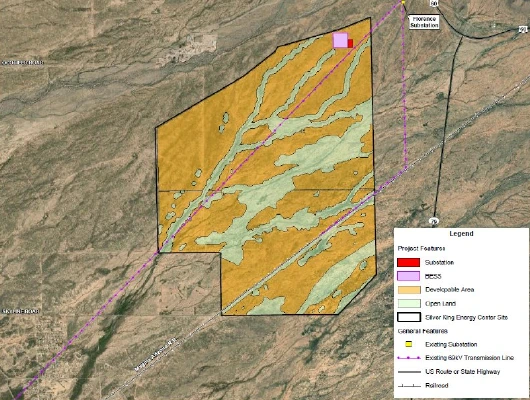
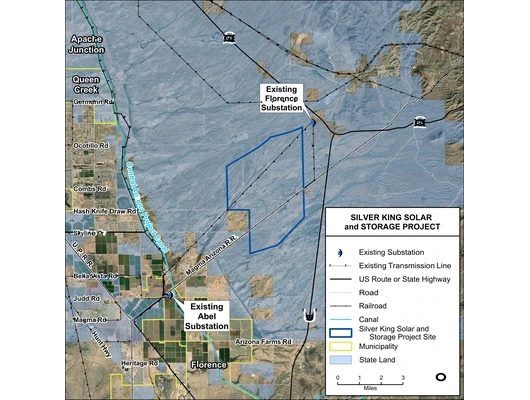
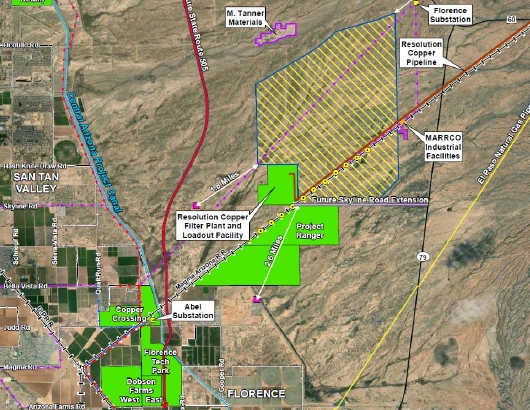
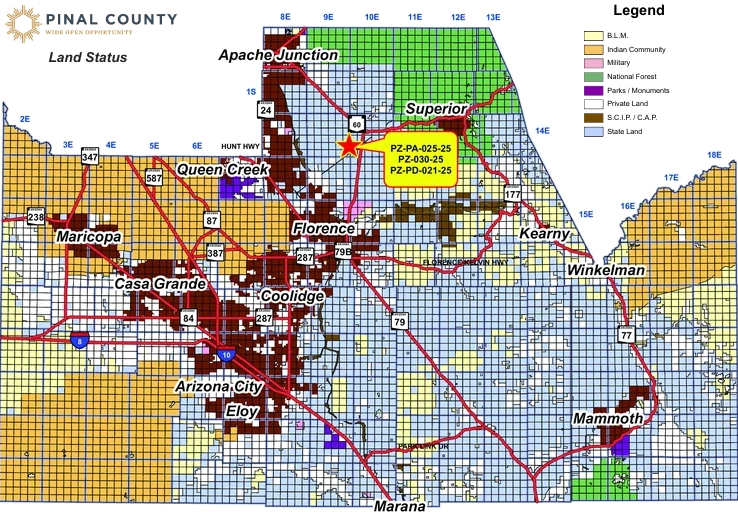
Silver King Solar LLC, a subsidiary of Arevia Power, seeks to build an energy facility on Arizona State Trust Land. The site sits southwest of Florence Junction, northeast of the Town of Florence, south of Queen Creek Wash, and five miles north of East Arizona Farms Road.
At full build-out, the project would include up to 800 megawatts of solar generation, up to 800 megawatts of battery storage with four-hour discharge capacity, and up to 400 megawatts of natural gas thermal generation. The total application area covers 8,122 acres. About 6,671 of those acres are designated for solar. However, washes, wildlife corridors, and buffer areas would reduce the buildable solar footprint to roughly 4,500 to 4,600 acres, according to the developer.
Most of the site would be dedicated to solar and battery infrastructure. A smaller portion — roughly 1,451 acres — would support the natural gas facility and future employment uses such as offices, warehouses, and commercial development.
The three applications before the Board include a Comprehensive Plan Amendment, a rezone from General Rural to Industrial, and a Planned Area Development overlay, which defines what can and cannot be built on the site.
How the Silver King Project Reached This Point
Arevia Power first proposed a version in 2025 that sought a Major Comprehensive Plan Amendment for up to 1,100 megawatts of solar and 1,100 megawatts of battery storage. The Pinal Post covered that initial proposal in July 2025 during a Planning and Zoning Commission work session.
The Citizens Advisory Committee recommended denial of that version. Before the commission could vote, however, the developer withdrew the application in October 2025. The developer did not provide a public explanation at the time.
In its place, the applicant submitted a revised proposal in late 2025. This version added a natural gas thermal generation component and mixed employment uses. It requested a change to the Special District land use designation — a flexible category that allows a mix of uses including energy production and employment. This designation is available only for State Trust Land. Because of that designation, the Pinal County Comprehensive Plan classifies the application as a non-major amendment, which can be heard at any regular meeting. By contrast, major amendments are limited to one hearing cycle per year. The earlier version of the project required a major amendment. The revised version did not.
On January 15, the Planning and Zoning Commission held public hearings on all three applications. After nearly three and a half hours of discussion, commissioners voted 4-3 to recommend denial of each one. The Board of Supervisors now holds the final decision.
Arguments in Favor of the Silver King Energy Center
County staff recommended approval. Staff analysis, the developer’s economic study, and hearing testimony each provided arguments in favor of the project.
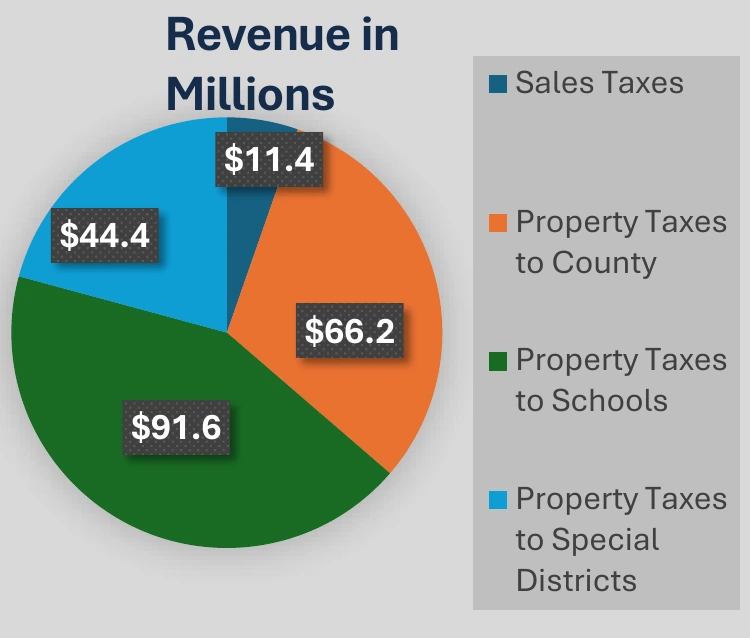
Tax revenue and economic impact. The applicant’s economic study projected $202.3 million in property taxes over the project’s lifetime. Of that amount, Pinal County would receive $66.2 million, school districts $91.6 million, and special districts $44.4 million. The study also projected $11.4 million in sales tax revenue for Pinal County from equipment purchases and construction.
Additionally, the project would generate approximately $202 million in lease, capacity fee, and land purchase payments to the Arizona State Land Department. Those payments benefit state trust beneficiaries, primarily public education. The developer estimated $2.9 billion in total capital expenditures.
Job creation. The project would support an average of 602 construction jobs annually over a 3.25-year build-out for the solar and battery phases. Peak construction employment would reach nearly 1,000 jobs.
Low water use. Staff analysis showed the solar facility would use 75-90% less water than residential development on the same acreage. It would also use 90-98% less water than agriculture. During operations, the project would require about 20 acre-feet of water per year for panel washing.
Grid reliability. The applicant’s representative, Alex Hayes, told commissioners that Salt River Project plans to double or triple its system capacity. Hayes cited SRP’s Director of Resource Planning, Bill McClellan, who said at a Board of Supervisors special session that Pinal County is expected to account for 30% of that growth. Hayes also said the project is in advanced commercial negotiations with an undisclosed end user in Pinal County. That user, at the low end of its projections, is expected to produce nearly $1 billion in economic output, he said, though he could not share details due to nondisclosure agreements.
Interim use before residential development. Hayes described the solar project as a productive bridge use. He said Land Advisors, a land brokerage firm, found that residential demand for the project area is at least 40 years away. The 30-year solar lease would align with that timeline. After decommissioning, the land would become available for future development.
Support from business community. Steven G. Zylstra, president and CEO of the Arizona Technology Council, submitted a letter supporting the project. He wrote that it would help Pinal County remain competitive in attracting businesses that value sustainability and innovation.
Decommissioning protections. The developer submitted a draft decommissioning plan. Dave Lundgren, Vice President of Development at Arevia Power, said a third-party bond would cover removal costs. He estimated that similar projects typically carry bonds ranging from $25 to $50 million, revisited every five to 10 years.
Community contributions. Hayes said Arevia Power has contributed $175,000 to local organizations to date. The company is also negotiating a development agreement with the county for regional transportation funding and a separate agreement with the Superstition Fire and Medical District for additional infrastructure contributions.
Arguments Against the Silver King Energy Center
Commissioners who voted for denial raised several concerns during the January 15 hearing. Public commenters also raised concerns.
Vague mixed-use plans. Vice Chairman Robert Klob said the applicant had not demonstrated how the 1,451-acre employment portion of the site would actually be developed. “Show me, don’t tell me,” Klob said. He noted that, in theory, as little as one acre of employment use could satisfy the requirement. Commissioner Wallace Keller agreed. “It’s just too vague,” he said. “Way too vague for what it is and the amount it is and where it’s going.”
Undisclosed power customer. Klob questioned the value of the applicant’s claim about an end user under a nondisclosure agreement. “We can’t talk about it, we don’t know about it,” he said. “Well, then technically they don’t exist at this point. Hard to approve something that is, you know, a maybe, we can’t tell you.”
Few permanent jobs. The applicant’s economic study estimated 13 direct permanent jobs across all three phases once construction is complete. San Tan Valley Town Manager Brent Billingsley noted in written comments that the project narrative estimated only 10 to 15 long-term operational jobs for the solar component alone.
San Tan Valley concerns. Billingsley also raised broader concerns about the project consuming thousands of acres of developable land adjacent to the town. He noted that the Arizona State Land Department had not contacted San Tan Valley about the proposal despite its proximity. County staff summarized that the town “has concern about locating large industrial solar, gas-fired power plant, and other heavy industrial development adjacent to the town in general.”
Where the power goes. Phillip Todd, a Gold Canyon resident, raised concerns about whether the energy produced would serve local customers. He noted that power enters the grid and could be sent anywhere, citing the SunZia transmission line sending power from New Mexico to California. “I think we need to use our land for infrastructure for our people out here,” he said.
Concerns about the Special District pathway. Commissioner Karen Mooney questioned whether the applicant added mixed-use elements specifically to qualify for the Minor Comprehensive Plan Amendment process. The original proposal required a Major Comprehensive Plan Amendment, which is heard only once per year. “Did you add the mixed use so that you could, since it was withdrawn from the major comp plan, you didn’t have to wait till next year’s major comp plan changes?” she asked.
Tax revenue questions. Commissioner Tom Scott questioned the tax revenue projections. He described a solar project in Coolidge that was promised to deliver $1 million annually but instead started at $48,000 per year, dropped to $44,000, and declined further to $38,000. Chairman Morris Mennenga estimated that residential development on the same 8,000 acres would produce 20 to 30 times the tax revenue of the solar project.
Lease payments benefit the state broadly. Lundgren said the $202 million in ASLD payments would flow to state trust beneficiaries across Arizona. The primary beneficiary for this property would be Arizona State University through the Normal School trust designation. Lundgren said he could not say how much would return directly to Pinal County.
Impact on future transportation and growth. John Krieg, a Queen Valley resident, raised concerns during public testimony about the project’s effect on a planned freeway corridor. He said that if the North-South Corridor comes through Florence Junction, the surrounding State Trust Land would be more valuable for housing and commercial development. “When you take 8,000 acres and you put houses on that, the property value of that and the taxes you’ll get off of that 8,000 acres is much more,” he said.
Wildlife displacement. Commissioner Mooney raised environmental concerns during both the July 2025 work session and the January 2026 hearing. “The animals, no matter how big or small, they’re just being driven out,” she said. The project area contains washes and corridors identified by Arizona Game and Fish as important wildlife movement areas. The site is home to species including mule deer, javelina, and kit fox. Hayes said roughly 2,000 acres would remain as open space along drainage corridors. Pat Golden, a wildlife biologist with Heritage Environmental Consultants hired by the developer, said those washes would not be fenced. Mooney voted for denial.
Fire response questions. Commissioner Scott cited 55 battery storage fires at U.S. facilities between 2018 and 2025. He asked how first responders would fight a fire at a remote site with no water supply. Hayes said he did not think he had a specific answer but that on-site water needs would be determined through fire response mitigation plans developed in coordination with the fire district.
Thermal generation emissions. Todd, who worked in GE’s gas turbine division from 1968 through 2023, also raised technical questions about the 400 MW thermal component. He said the applicant had not clarified whether the turbines would operate as peaking or base-load machines. That distinction affects emissions levels. He noted that reaching the lowest NOx emission levels would require adding ammonia to the exhaust system.
Rail access for future industrial development. Klob pointed out that communities across Pinal County use rail access to attract industrial employers. “In Maricopa, we’ve allocated special space just for rail line development, industrial development,” he said. “Casa Grande’s been making a killing at doing it for numerous years.” He questioned whether a 30-year solar lease would block better economic uses of the rail corridor.
What Happens on February 18
The Pinal County Board of Supervisors will hold a public hearing on February 18 at 9:30 a.m. at the Pinal County Administrative Complex, 135 N. Pinal Street, Florence. The agenda item covers all three applications. The motion for the Comprehensive Plan Amendment recommends approval with no stipulations. The rezone and Planned Area Development cases include separate stipulations.
The Board can accept the commission’s denial recommendation, approve the project despite that recommendation, or return it for further consideration. The project falls within Supervisor Districts 5 and 2. Residents may attend and comment during the public hearing.