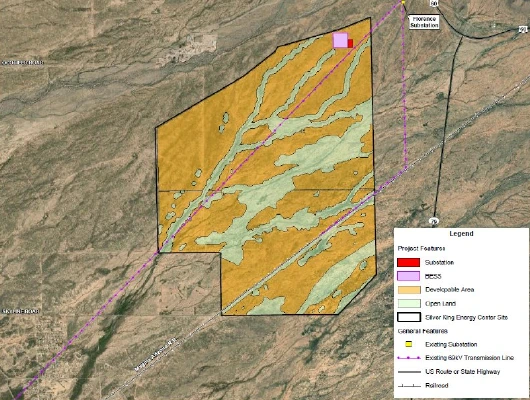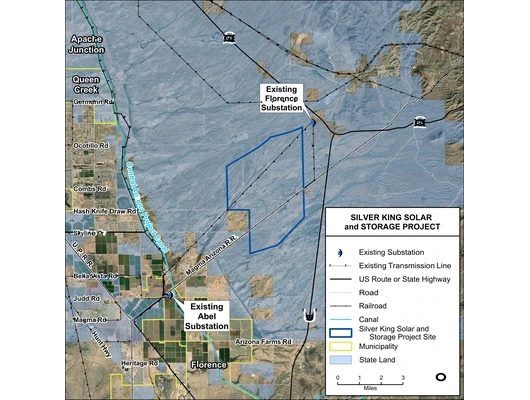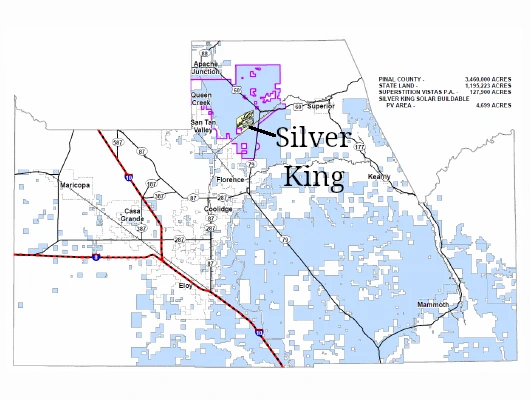
The Pinal County Board of Supervisors unanimously denied all three applications for the Silver King Energy Center on February 18, 2026. The proposed project near Florence Junction spanned 8,122 acres. It would have been the county’s largest energy development. It included up to 800 megawatts of solar, 800 megawatts of four-hour battery storage, and 400 megawatts of natural gas generation. Staff had recommended approval. The applicant had argued the project would power the Florence Technology Park, a 780-acre data center development unanimously approved by the Florence Town Council.
The Pinal Post has covered this project extensively since its first proposal in 2025. Previous coverage includes the initial proposal discussed at a July 2025 work session, the developer’s withdrawal in October 2025, the revised 8,122-acre application, and the Planning and Zoning Commission’s 4-3 denial recommendation on January 15. Those articles cover the project’s history, location, wildlife corridors, water use, decommissioning plans, federal tax credits, rail line impacts, and fire safety. This article focuses on new information and arguments from the Board of Supervisors hearing.
Florence Technology Park Contract Revealed
The applicant said the Silver King Energy Center would directly power the Florence Technology Park. At the January Planning and Zoning hearing, attorney Alex Hayes could only reference an undisclosed customer under NDA. At this hearing, he identified the customer. It is the Ryan Companies and their Florence Technology Park, a project unanimously approved by the Florence Town Council.
“This project does not come to fruition, it doesn’t become reality, it doesn’t start creating revenue for the town and for the county, at least not in the next five to seven years, but for your approval of this project here today,” Hayes said.
Hayes described the technology park’s projected economic impact. “It will contribute over $893 million in total economic output,” he said. “That is through phase one of their multi-phase development, and that is just the construction phase.” He added that the operational phase would generate “about $9 million in revenue” annually to Florence and “about $8 million to the county.” Hayes said those figures were “on top of the $213.7 million in direct taxes from Silver King itself that would contribute to the county over the life of that project.”
However, the connection between Silver King and the technology park depended on Salt River Project, the utility serving this area.
SRP Contract Debate
Supervisor Rich Vitiello questioned the applicant about the lack of a contract with SRP. He noted that SRP serves only a portion of Pinal County and questioned whether the power would actually stay local.
“There’s maybes, buts, and no guarantees to any of the portion outside of Ryan Group is what I’m getting at,” he said.
Hayes asked to bring up Dave Lundgren of Arevia Power to explain the process. Lundgren said Silver King cannot deliver power directly to the Florence Technology Park because the developer is not allowed to contract directly with end users in SRP’s service territory. Instead, the power must flow through SRP’s system. Lundgren described SRP as “the middleman” managing how power enters and leaves their grid.
“We are going to plug into their facility, which is the Abel Substation, and from there, the power is gonna be distributed by SRP,” he said. “The contract that we have with the Ryan Companies is real. It’s a binding contract. We are obligated to provide power to them by date certain.”
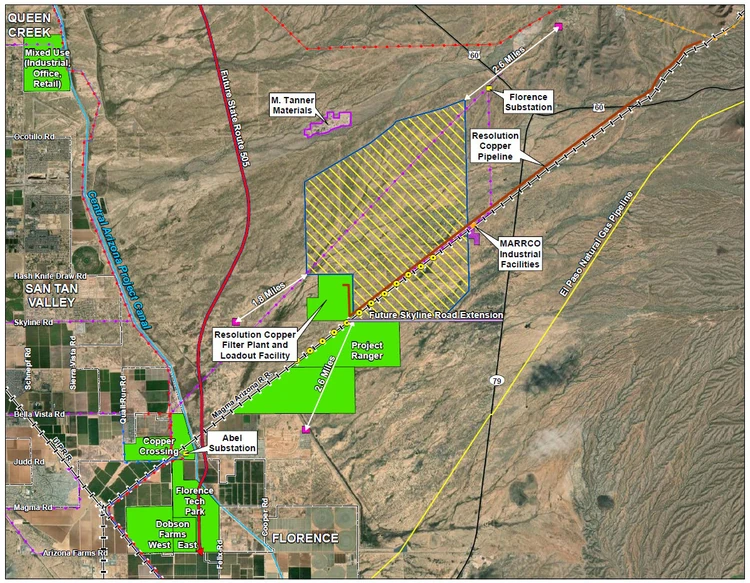
Regarding the interconnection process, Lundgren clarified that Silver King was in SRP’s queue. “We are in SRP’s interconnection queue process. That is official. It is submitted,” he said. “It is not a contract.”
Vitiello remained unconvinced. “I got right here a letter from SRP telling me that they have nothing in the hopper with you at all,” he said.
Supervisor Stephen Miller clarified the queue process. He noted that other generators are likely in the same position — in the queue without contracts. “If we build this, you know, then we’ll move forward with contracts,” Miller said. Lundgren confirmed that was correct.
When asked directly whether the project would proceed without a utility contract, Lundgren said no. Supervisor Mike Goodman asked the question plainly, and Lundgren responded: “No, sir.”
SRP’s Role in Pinal County and Power Demand
The hearing also addressed SRP’s broader role in the county’s energy future. Hayes referenced a special session the Board of Supervisors held with utility representatives in the fall. “SRP came and they said that they plan to more than double, if not triple, their system over the next decade,” Hayes said. “And 30% of that system growth, of that load growth, is occurring in Pinal County with the commercial and industrial uses.”
Hayes said the Silver King Energy Center would address part of that demand. He described the project site as sitting between the existing Florence Junction Substation and the Abel Substation. “This project will upgrade that Florence Junction Substation and the transmission line to Abel, all at Silver King’s expense,” he said.
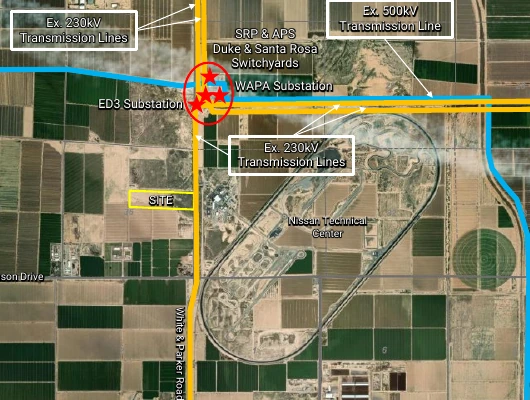
Hayes described the power delivery path. “Silver King Energy Center will deliver power to the Abel Substation. The Florence Technology Park will pull power from the Abel Substation,” he said. The Ryan Companies facility sits less than a mile from the Abel Substation.
However, Hayes acknowledged the gap in formal agreements. “At this point today, Silver King does not have a contract with Salt River Project,” he said. SRP could not include the project in resource planning until it received entitlements from the county.
Vice Chairman Jeff Serdy disagreed. “The project in Florence, that thing’s happening with or without this project. SRP has enough power. I’ve talked to SRP employees,” he said. He added that the nearby Box Canyon solar project was “having no effect” on electricity bills.
Silver King Energy Center Tax Revenue
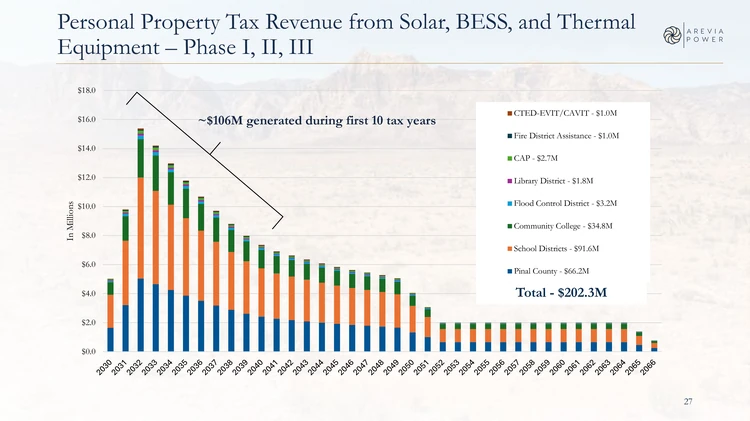
Hayes described the $213.7 million in direct taxes as “personal property tax and sales tax.” The applicant’s economic study breaks down that figure.
The applicant’s economic study projected $202.3 million in property taxes over 35 years across all local jurisdictions. It separately projected $11.4 million in construction-phase sales taxes within Pinal County, including $11.2 million to county government and $0.2 million to municipalities. Together those total $213.7 million, matching Hayes’s figure. The $202.3 million in property taxes is distributed across multiple entities: $66.2 million to Pinal County government, $91.6 million to school districts, and $44.4 million to special districts.
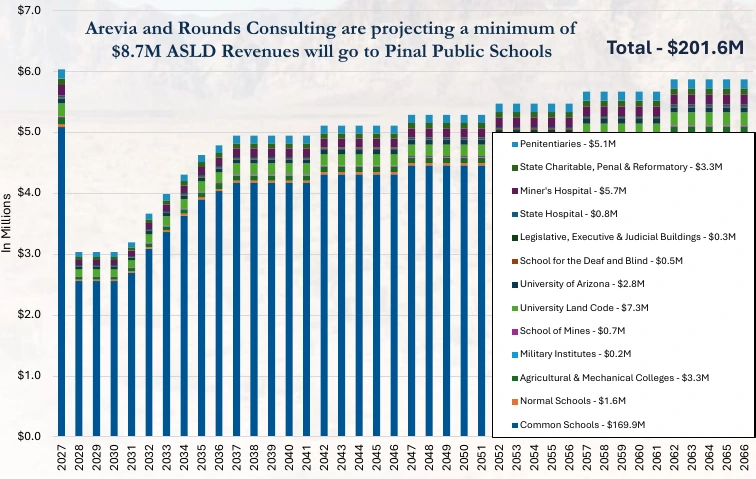
Separately, the economic study projected $201.6 million in lease and capacity fee payments to Arizona State Land Department beneficiaries over the life of the project. The primary beneficiary would be Arizona State University through the Normal School trust designation. These payments flow to state trust beneficiaries rather than to Pinal County directly.
Additionally, Hayes said the project would provide a minimum of $15 million through a proposed development agreement for transportation infrastructure. He described the contribution formula as “$12,500 per megawatt” of generation capacity.
Special District Designation
The applicant sought a Special District land use classification, a designation adopted specifically for Arizona State Trust Land. Senior Planner Valentyn Panchenko explained that any change to or from the Special District on State Trust Land qualifies as a non-major amendment “despite the scale of the project.” As a result, the 8,122-acre application went through the non-major amendment process rather than the major amendment the developer originally pursued.
Planning and Zoning Commissioner Karen Mooney raised this during public comment. “This property went through the Major Comp Plan Amendment process last year through the county and then was pulled from the P&Z agenda in October,” she said. “It then came back as a special district process circumventing the Major Comp Plan.” She also asked what would prevent the southern portion of the project, designated for natural gas and employment uses, from eventually becoming more solar. The board ultimately denied the request to change the land use designation to Special District.
Setback Comparison to Box Canyon Solar
Hayes used video simulations to argue the project would have minimal visual impact from Highway 79 and U.S. 60. He drew a contrast with the existing Box Canyon solar facility.
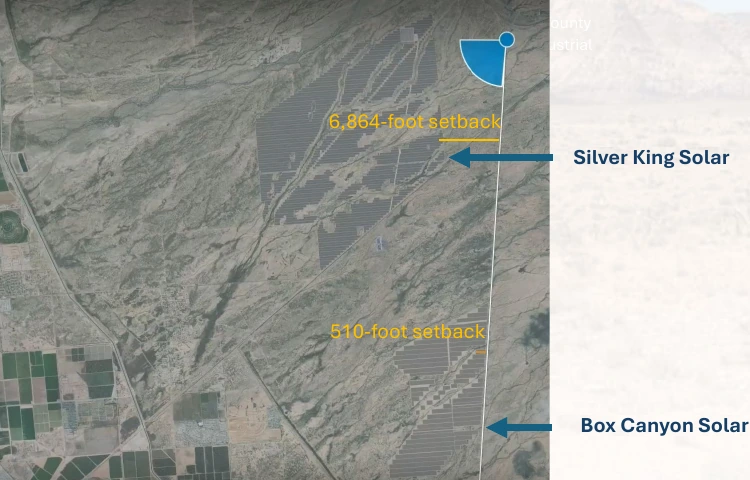
“That is separated from 79 by, I think, 500 feet,” Hayes said of Box Canyon. “So we have a separation of, I think, about 6,800 feet, so a significantly more substantial buffer and setback compared to Box Canyon.”
Serdy challenged the visual simulations. He said the applicant had edited out vegetation and that ADOT had cleared vegetation in the area. “The actual site is much more vegetated than that,” he said.
Jobs and Employment Debate
Vitiello questioned the project’s job creation beyond the construction phase. Hayes said the solar component would produce about 10 full-time jobs. The natural gas thermal generation would typically employ 20 to 30 full-time operations personnel.
Vitiello said even with the employment uses factored in, the permanent job count was too low for the land committed. “Economic development to me means jobs, not 100 jobs,” he said.
Hayes responded that the 1,300 acres entitled for employment uses in the southern portion of the project would attract additional employers. He also argued that powering the Florence Technology Park would create jobs indirectly. “Having the power to support development in the county is economic development and is job creation,” he said.
Hayes said the project’s capital expenditures totaled $2.9 billion and would create an estimated 2,350 full-time equivalent construction jobs over the build-out period.
Support and Opposition
County staff received 39 letters of support representing 43 people and 84 letters of opposition representing 97 people. The Town of San Tan Valley submitted a letter opposing the project. Hayes said his team had gathered over 100 letters of support.
Vitiello noted that roughly 98% of opponents “live right there,” while 25 to 30 supporters were from outside the area. Serdy said “hundreds of more letters got purged” when the original application was withdrawn, and many opponents did not resubmit.
Public Comments
Fourteen members of the public submitted speaker cards. Additional speakers addressed the board without cards.
Brenda Hiscox of Coolidge appealed to the board to “side with the stakeholders, not developers from out of state.” She noted the county had already approved about 40,000 acres of solar. She questioned whether the project was primarily a solar development or a way to use federal tax credits and power purchase agreements to subsidize infrastructure that would attract industrial users. “We would like to use the federal tax credits and the PPAs and have you pay for this part of it, taxpayers, so that we can entice the other stuff to get here, after the fact,” she said.
Tom Scott of Coolidge, who also serves on the Pinal County Planning and Zoning Commission, spoke in opposition. He questioned the applicant’s economic projections, citing his experience with a solar project in Coolidge that delivered far less revenue than projected. Scott also raised water concerns from the applicant’s proposal. He cited 700 acre feet for construction and 2.3 million gallons daily for thermal generation.
John Krieg of Queen Valley, who worked at a gas-fired power plant in Alaska for 20 years, opposed the project. “You don’t build a 400 megawatt plant and decommission it in 30 years. That is a fact,” he said. “And what about the emissions from that plant?” He also said the project’s scale would limit the full development potential of the Superstition Vistas area and block the Highway 24 corridor from reaching Florence Junction.
Barby Ingle of Apache Junction said the Sonoran Desert ecosystem cannot be restored after decommissioning and that the project would be visible from further away than the applicant’s simulations showed.
Cepand Alizadeh of the Arizona Technology Council said the county needs energy infrastructure to attract semiconductor and defense employers. Don Seifert, a rancher near the project site, said the county will need the electricity either way. He argued it is better to approve one large project than deal with many smaller energy projects across Florence, Coolidge, and Casa Grande over the next five years. James Pirtle, a Florence resident and IBEW Local 640 member, said he lives on the San Carlos Irrigation system and has unreliable power. He saw the project as a chance to bring dependable electricity to the area.
Several union representatives from IBEW Local 640, Operating Engineers Local 12, and LiUNA spoke in support. They emphasized the value of multi-year construction jobs close to home.
Serdy: ‘Worst Project’ in 20 Years of Public Office
Serdy spoke against the project before the vote. “This is the worst project that I’ve encountered in 20 years of public office,” he said. “There’s already 40,000 acres of solar approved for Pinal County. You’re not even gonna see an impact from that.”
He predicted micro nuclear technology would arrive within five years. “There is no waste for micro nuclear. You can power a whole submarine with it, a whole aircraft carrier,” he said. He noted the technology is portable. Recently, a unit was flown across the country. “There are six bills in the US Congress right now for micro nuclear, and there’s one in the Arizona House,” he said.
Serdy disputed industry claims that the technology is not ready. “This company will tell you they don’t have the technology. China’s already using it. We do have the technology,” he said.
He also described the project area as Sonoran Desert within a tourism corridor. “When you go to the west part of the county, it doesn’t look like this,” he said. “It’s played out cotton fields, it’s creosote. This is not what you have here. This is the true Sonoran Desert. So this is not an inconsequential place.”
Goodman Cites Gilbert Gas Plant
Supervisor Goodman spoke favorably about the project during discussion. He said the county needed energy infrastructure to support economic development and retain young workers.
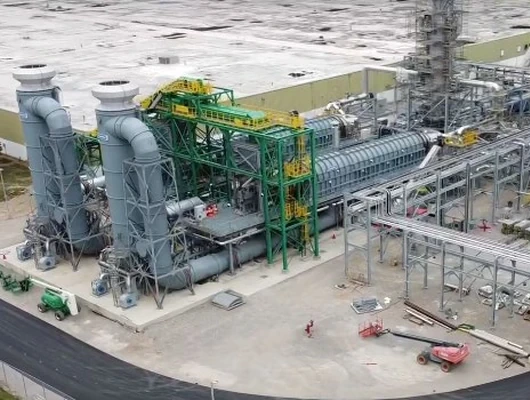
He compared the proposed natural gas component to an existing facility. “You’ve heard me say this multiple times, in the town of Gilbert, right smack dab in the town of Gilbert, there is a gas-powered generator that SRP owns,” Goodman said. “They have methodically put landscape around that.” He added that “high-end homes have been built around that facility. People do not complain about the noise that was brought up here earlier.”
Goodman acknowledged Serdy’s support for nuclear energy. “I’m a big proponent of the nuclear power that you speak of, Supervisor Serdy, and you and I are on the same page when it comes to that,” he said. “But I also see things, how far out is that going to go? We have immediate projects that are at our doorstep right now, today, that will bring more employment opportunities here to our youth and to the people that live here currently.”
Miller Addresses Nuclear Timeline
Supervisor Miller said he had spoken with both SRP and APS about nuclear energy in detail. He reported that only two nuclear projects are under construction nationally. “Everybody in the United States is sitting around watching them build this thing,” he said. He noted that no one knows the final cost or timeline.
Miller estimated the earliest Arizona would permit a nuclear generation project at 10 to 12 years away. He also questioned whether reactors would be allowed on state trust land.
“The pros and the cons on this, to me, are 50/50,” Miller said. He pushed back on the argument that solar would consume valuable open space, noting that any future development — whether commercial, residential, or otherwise — would have the same effect. “If we bring businesses in, any other type of business, whatever it is, it’s gonna use land,” he said, arguing that opposing solar on those grounds was inconsistent unless one opposed all development entirely.
Executive Session and Final Votes
After public comments and board discussion, Deputy Chief Christine Roberts recommended an executive session. She cited legal issues related to statements about the development agreement. The board briefly entered executive session before returning.
Hayes offered a continuance before the vote. He suggested the applicant could deliver a finalized development agreement and additional SRP documentation. The board declined.
Vitiello made the motion to deny all three items. Serdy seconded each motion. No supervisor voted in opposition.
The board denied the comprehensive plan amendment (Resolution No. 2026-PZ-PA-025-25), the rezone (Ordinance No. 2026-PZ-030-25), and the planned area development overlay (Resolution No. 2026-PZ-PD-021-25).
Silver King Energy Center After the Board Vote
The unanimous denial marks the second time the Silver King project has failed to advance. The developer withdrew an earlier version of the application in October 2025. This revised version received a 4-3 denial recommendation from the Planning and Zoning Commission in January. The board then denied all three applications.
The 8,122 acres of Arizona State Trust Land near Florence Junction will remain as Moderate Low Density Residential with General Rural zoning. No further county action is required unless the developer submits a new application.