Key Points
- Two providers presented to San Tan Valley’s council: Queen Creek provides water service only; EPCOR provides both water and wastewater service.
- Both providers have new rates in 2025: Queen Creek approved a water rate increase in July. EPCOR’s new rates were approved by the Arizona Corporation Commission—the first rate case since acquiring Johnson Utilities.
- Queen Creek is diversifying its water portfolio by acquiring Harquahala Valley water rights to reduce reliance on the Central Arizona Groundwater Replenishment District (CAGRD).
- EPCOR has made significant system improvements since taking over from Johnson Utilities in 2018.
- Both providers emphasized long-term water planning, conservation programs, and wastewater recycling.
Two water utility providers outlined their services, rates, and long-term strategies before San Tan Valley’s newly incorporated town council on December 3, 2025. Marc Skocypec, Queen Creek’s Utilities Director, and EPCOR representatives Jacob Rogers and Victoria Samwick delivered presentations on their respective operations. The meeting was an informational session only, giving council members their first detailed look at the utilities serving residents across the area.
What This Means for San Tan Valley Residents
San Tan Valley residents receive water and wastewater services from different providers depending on their location. EPCOR operates the San Tan Water and Wastewater districts, covering parts of Queen Creek, San Tan Valley, and the Anthem area of Florence.
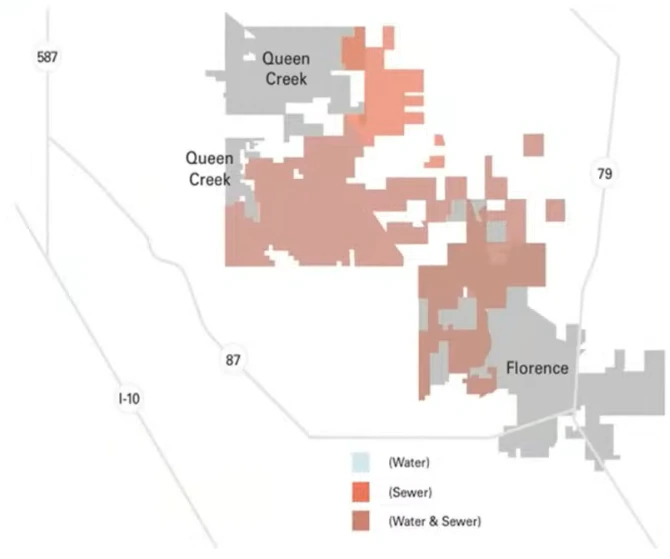
The Town of Queen Creek operates its own municipal utility, with water service extending into portions of north and east San Tan Valley, though its wastewater service does not overlap into San Tan Valley.
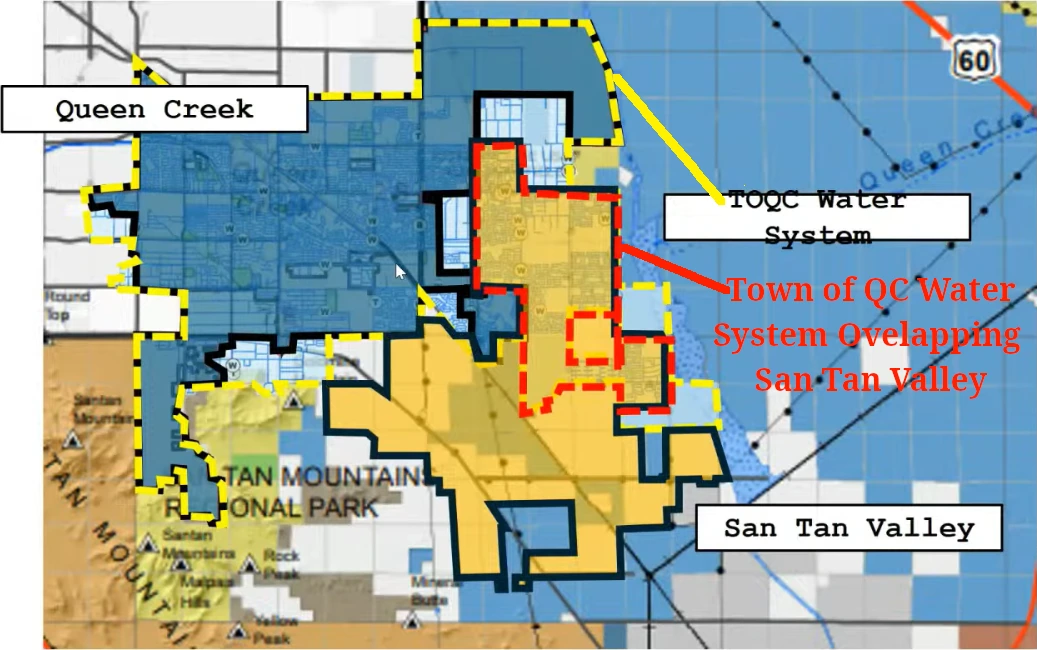
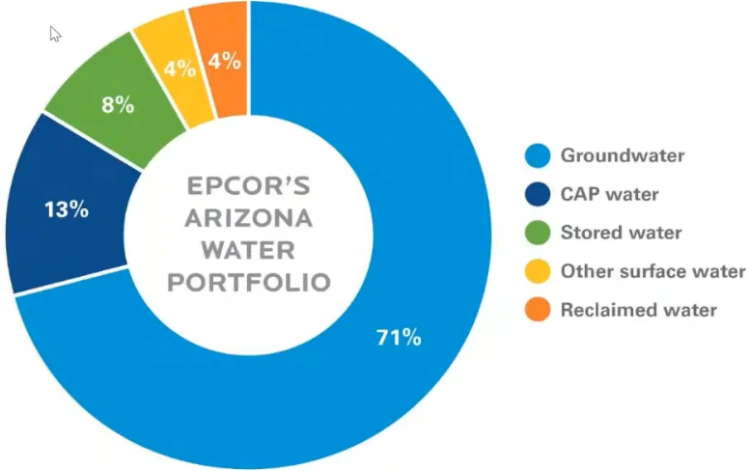
The two providers operate under different rate structures and regulatory frameworks, and their water portfolios differ in composition. Both presenters emphasized long-term planning to secure water supplies for future generations.
Provider Comparison at a Glance
| Queen Creek | EPCOR San Tan | |
|---|---|---|
| Services to San Tan Valley | Water only | Water and wastewater |
| Current Water Connections (entire service area) | 45,000 | Approximately 31,000 (2024) |
| Rate Regulation | Town Council | Arizona Corporation Commission |
Queen Creek Rate Increases and New Fees
Queen Creek’s ultimate goal is to become a designated water provider. This status would give the town local control over its water future and the ability to lock in pricing for its buildout demand, providing long-term cost stability. To achieve this, the town must reduce its dependence on groundwater and the Central Arizona Groundwater Replenishment District (CAGRD).
In his December 3rd presentation, Skocypec explained Queen Creek’s relationship with CAGRD. Queen Creek was not part of historic water allocations and developed on groundwater. Under Arizona law, all groundwater used must be replaced. CAGRD handles that replenishment on behalf of member communities.
However, Queen Creek cannot control CAGRD or its rates, which have consistently increased. These costs get passed to customers through a fee on property tax bills. Skocypec called this reliance “costly and unsustainable,” projecting $40 to $50 million or more annually at buildout.
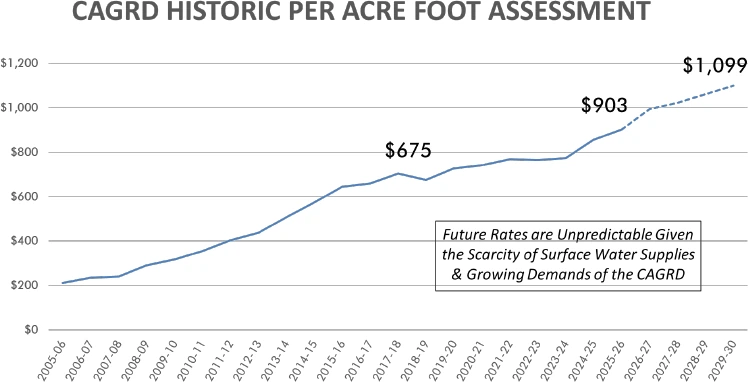
To reduce its CAGRD obligations, Queen Creek is acquiring non-groundwater resources like Harquahala water. A new water resource fee would fund these acquisitions. Because Queen Creek controls the fee—unlike CAGRD—costs would be more stable and predictable for its customers, including those in San Tan Valley.
Queen Creek approved a 15% water rate increase in July 2025, which San Tan Valley residents in Queen Creek’s service area are now seeing reflected in their bills. The increase translates to $3 to $6 per month for most residential customers. The new rates took effect August 27, 2025. System infrastructure improvements, rising costs for renewable water supply, and other essential services drove the increase. Sewer rates were not affected.
Town records indicate the council directed staff to develop a new water resource fee, which would cost customers less per acre-foot than CAGRD.
Queen Creek officials said the town saved customers $58 million in CAGRD assessments over seven years through various mitigation efforts. However, town officials said those offsets were short-term solutions. The new fee would provide a more stable alternative while funding water acquisitions for a 100-year supply.
Queen Creek’s Major Water Purchase
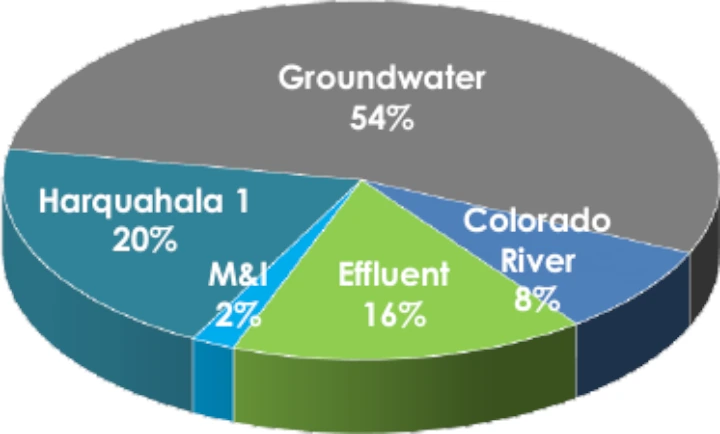
Skocypec’s presentation highlighted Queen Creek’s Harquahala water acquisitions. He noted that the first phase of the Harquahala acquisition is complete, with water now being transported to Queen Creek and comprising 20% of the town’s portfolio. The second phase, which would add another 48% to the portfolio, is pending.
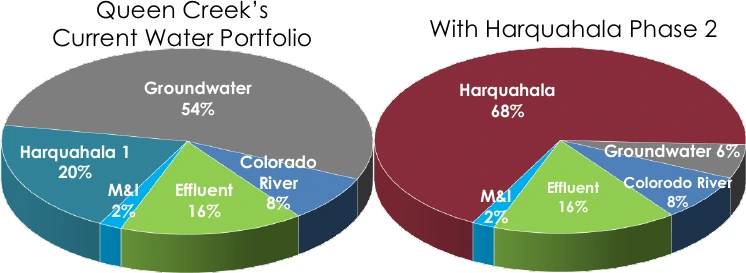
Arizona law generally prohibits transporting groundwater between basins, but the 1991 Groundwater Transportation Act permits transportation from four sub-basins, including Harquahala. Queen Creek has committed $244.4 million to purchase 1.2 million acre-feet of water rights from the valley. In July 2025, the Arizona Department of Water Resources approved Queen Creek’s proposal for transporting groundwater from the basin.
By 2026, Queen Creek expects groundwater to represent just 6% of its portfolio. Harquahala water will comprise 68% of the supply after the second phase closes.
Skocypec emphasized that Queen Creek’s goal is to own a water portfolio with 100-year assets that are less susceptible to and impacted by drought conditions. Colorado River water has faced limitations and shortages, making diversification a priority. The Harquahala basin is experiencing aquifer depletion due to local agricultural use, but ADWR approved Queen Creek’s proposal because it includes commitments from local landowners to reduce groundwater withdrawals for crop irrigation. ADWR concluded that the Harquahala aquifer would deplete at roughly the same rate—or slightly slower—than if no water were transported at all.
Queen Creek says this shift aims to reduce CAGRD obligations and provide more stable costs for customers in its service area, including those in San Tan Valley.
How EPCOR Sets Rates
EPCOR operates under Arizona Corporation Commission regulation. Rate changes must go through a formal 24- to 30-month process overseen by an Administrative Law Judge.
Rogers explained the basic rate formula: capital investment multiplied by return on investment, plus operating costs. The commission reviews expenses and investments for prudency and usefulness.
In July 2025, the ACC approved new rates for EPCOR San Tan in a unanimous 5-0 vote. This was the first rate case filed since EPCOR acquired ownership from Johnson Utilities. Vice Chair Nick Myers called it “the end of an era,” noting the rate increase was largely due to mismanagement under Johnson Utilities.
This regulatory framework differs from municipal utilities like Queen Creek, where town councils set rates through local hearings.
EPCOR’s Transformation Since 2018
EPCOR outlined system conditions from when it assumed operations of Johnson Utilities in 2018. The previous operator had accumulated more than 530 recorded complaints covering billing, health concerns, odor problems, and service failures.
In the year before EPCOR stepped in, the system experienced 78 sewer overflows. Water losses exceeded state standards at 24%. According to Rogers, one pipe leaked one million gallons per day for a decade.
Since officially purchasing Johnson Utilities assets in January 2021, EPCOR has invested more than $259 million in system improvements. EPCOR USA operates water and wastewater systems across Arizona, New Mexico, and Texas, serving more than 306,000 connections and over one million people.
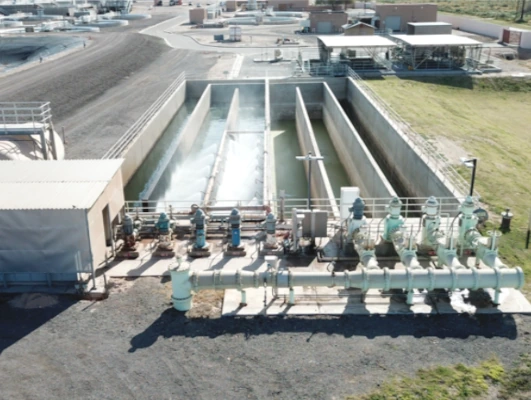
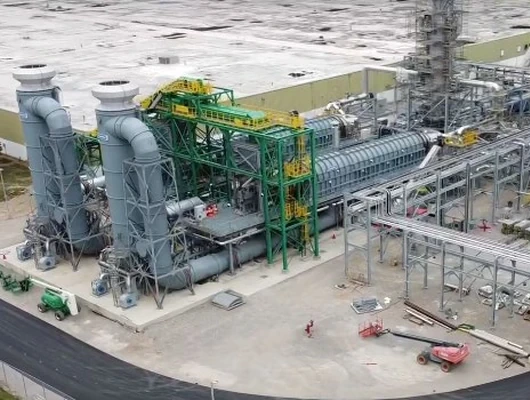
A key project is the $80 million Copper Basin Water Reclamation Facility, built to replace the troubled Section 11 plant. Section 11 used an open-air, lagoon-style treatment process that had deteriorated over years and was partially responsible for many of the issues customers experienced. Copper Basin, by contrast, is a fully enclosed 3-million-gallon-per-day facility with state-of-the-art odor control equipment. It uses biological processes rather than relying on chemicals to treat wastewater. The facility recharges 1 million gallons daily.
EPCOR also expanded the Pecan and Anthem facilities, each gaining 1 million gallons per day of capacity.
EPCOR Customer Assistance Programs
EPCOR offers programs to help customers manage bills. Low-income customers and disabled veterans can each receive a $10 monthly credit. Deployed service members may have their entire bill waived if they qualify.
Wastewater Recycling and Recharge
Both providers emphasized wastewater recycling as critical to water sustainability.
According to EPCOR, the company recycles 95.9% of treated effluent and has returned 26 billion gallons of purified water to what it calls “the natural cycle.”
Queen Creek recycles treated wastewater to replenish groundwater, accounting for 16% of its water supply. The town has partnerships in place for wastewater recharge and is developing a groundwater storage facility with Queen Creek Irrigation District.
Conservation Programs and Technology
Both providers offer conservation tools to help customers reduce usage.
According to Rogers, the system lost 3.65 billion gallons of water under Johnson Utilities—including one pipe that leaked one million gallons per day for a decade. EPCOR now provides leak detection assistance through Conservation Specialists, and the WaterSmart platform and Advanced Metering Infrastructure give customers tools to monitor usage in real time. EPCOR also offers self-audit kits, low-flow retrofit kits, and landscape watering guides.
Queen Creek launched a Waterfluence program working with homeowners associations. The town reports this effort saved more than 47 million gallons last year. Electronic meter reading with real-time shutoff and turn-on capabilities now serves customers.