Key Points
- Pinal County presented a 10-year housing plan at a March 11 Board of Supervisors work session.
- The plan targets 390 economically sustainable homes by 2035 through new construction, homeownership assistance, and rehabilitation.
- Initial development will focus on two county-owned sites — Eleven Mile Corner, an unincorporated community between Casa Grande and Coolidge near the Pinal County Housing Authority, and multiple parcels in and around Eloy formerly associated with the Eloy Housing Authority.
- 296 low- and moderate-income renters in unincorporated Pinal County are currently cost-burdened, paying more than 30% of their income on rent.
- Housing will be built in partnership with nonprofits, not by the county directly.
- Public comments on the draft plan are accepted through April 10, 2026.
The Pinal County Board of Supervisors received a presentation on March 11, 2026, about the Unincorporated Pinal County Housing Plan — a grant-funded strategy to create or preserve 390 economically sustainable homes by 2035. Consultant Martina Kuehl of Kuehl Enterprises LLC presented the plan, which grew out of an internal county task force. The plan is funded through a Local Jurisdiction Housing Planning Grant from the Arizona Department of Housing.
What the Plan Means for Unincorporated Pinal County Residents
The housing plan sets three goals to be achieved by 2035:
- Create or preserve 150 rental homes for low- and moderate-income households.
- Support at least 140 first-time homebuyers through new homes or home purchase assistance.
- Rehabilitate 100 homes.
A current waiting list of 36 households is seeking owner-occupied housing rehabilitation assistance. The Grants Department reports receiving 129 applications over the last five years and completing work on 63 homes — 58 finished and 5 in process.
Kuehl said homes between 20 and 30 years old tend to need major systems repairs, particularly among lower-income households that have had challenges with ongoing maintenance. “We had this huge housing boom in the early 2000s,” she said. “If they were built in 2001, it’s now a 25-year-old home.” The plan projects that 8,100 homes in unincorporated Pinal County will reach an age when major system repairs are likely to be necessary between 2026 and 2035. “I would anticipate, just given the scope of development that occurred during that period of time, that we will actually see an increase in demand for this program over the coming years,” she said.
Who Qualifies for Rehabilitation Assistance
Rehabilitation services are funded through Community Development Block Grant (CDBG) dollars. To qualify, a homeowner must meet low- and moderate-income thresholds. Kuehl said common repairs include roofs, heating and cooling systems, hot water heaters, and anything representing a health or safety issue. A contractor is then hired to bring the home up to current standards, she said.
Supervisor Stephen Miller asked about repayment requirements. Heather Patel, of the Office of Budget and Finance, explained that the program has three tracks depending on the scope of work. “Maybe it is just a roof,” she said, “and that is a grant.” For larger projects, Patel said, the county places a lien on the property — one that converts to a grant as long as the homeowner stays, but requires partial repayment to the county if they sell. The third track is the demolition and replacement program, which applies to approximately a third of the current 36 households on the waiting list.
Supervisor Miller noted that some rehabilitations are extensive enough to require families to be temporarily relocated. Patel confirmed the county has handled such cases. Supervisor Rich Vitiello, drawing on his background in construction, asked how contractors are selected for each project. Patel said the county maintains a list of five general contractors and cycles through them, soliciting a cost from each for individual projects.
Why Housing Costs Have Risen: The Newcomer Story
According to the plan, people moving into the county accounted for about 80% of all household growth between 2017 and 2022, a period that included the pandemic-era housing boom. About half of those newcomers came from Maricopa County, Kuehl said, and most settled in northern Pinal County.
According to Kuehl, the people arriving tended to be pre-retirement age, were previous homeowners, and carried incomes approximately $10,000 higher than non-moving households — and $20,000 higher than those leaving the county. Much of the income growth seen during that period, she said, reflects newcomers bringing purchasing power with them.
The remaining 20% of household growth came from what the plan calls new household formations — younger people leaving their family homes and households created by divorce. These households tend to have lower incomes, Kuehl said, and pursue rental units as a result.
Because those newcomers were seeking to buy single-family detached homes, Kuehl said, that demand drove single-family residential development. According to the plan, 88% of new home permits issued between 2020 and 2024 were for single-family detached homes.
Additionally, demand for second homes and investment properties put further upward pressure on housing prices. According to Pinal County Assessor data cited in the presentation, of 77,663 property transfers between 2020 and 2024, 57,657 (74%) were primary residences, 11,583 (15%) were non-primary residences, and 8,423 (11%) were rental or investment properties.
The Rental Housing Gap
The plan identifies 296 low- and moderate-income renters in unincorporated Pinal County who are cost-burdened — paying more than 30% of their income on rent — and in need of economically-sustainable rental housing.
What “economically sustainable” means varies by household type. For a single person over age 65 on a fixed income, that means a monthly rent of just $271 — 30% of a very low fixed income — “almost impossible to produce a unit that can rent at that low of a rent,” Kuehl said. For married couples with one or more incomes, that threshold rises to $1,112 per month.
The plan also identifies 275 middle- and higher-income renters who could potentially move into homeownership, reducing pressure on the rental market. Those homes are priced at up to $211,900 for households under 35 (25 homes), up to $249,100 for households ages 35 to 64 (175 homes), and up to $165,900 for households age 65 and older (75 homes).
Where Development Could Happen: Housing Opportunity Areas
Michael Baker International conducted the Housing Opportunity Areas analysis, contributing its data and mapping capabilities as a project partner. The analysis identified 11 housing opportunity areas across unincorporated Pinal County, organized into three tiers based on their readiness for housing development.
Tier designations reflect factors including existing development and infrastructure, proximity to major employers with 50 or more employees, utility availability and capacity, education opportunities, public transportation access, childcare centers, fresh food access, zoning and future land use designations, low poverty rates, and flood risk.
Tier 1 areas have the strongest combination of those factors. According to the plan, Tier 1 sites are best positioned to help residents build economic stability over time, and are where the county will focus its early development efforts. Initial housing production is focused on two Tier 1 sites — Eleven Mile Corner and Eloy — with future expansion to Tier 2 and Tier 3 areas tied to the county’s economic growth and the results of pilot incentive programs. Incentives that may be negotiated with development partners include density bonuses, flexible parking standards, reduced setbacks, lot area reductions, and lot coverage increases.
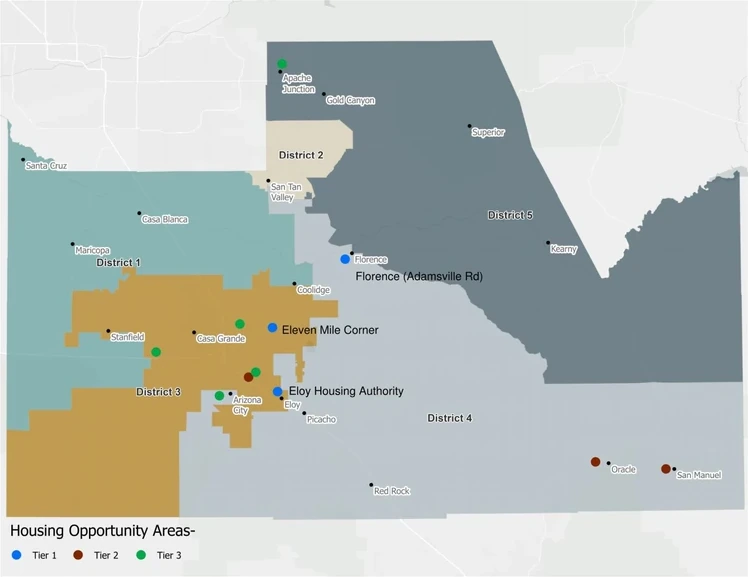
Of the 11 housing opportunity areas identified, three county-owned locations were initially evaluated for near-term development. The Adamsville Road site in Florence was dropped from consideration, Kuehl said, because it “was selected for other uses.” That left two active Tier 1 sites:
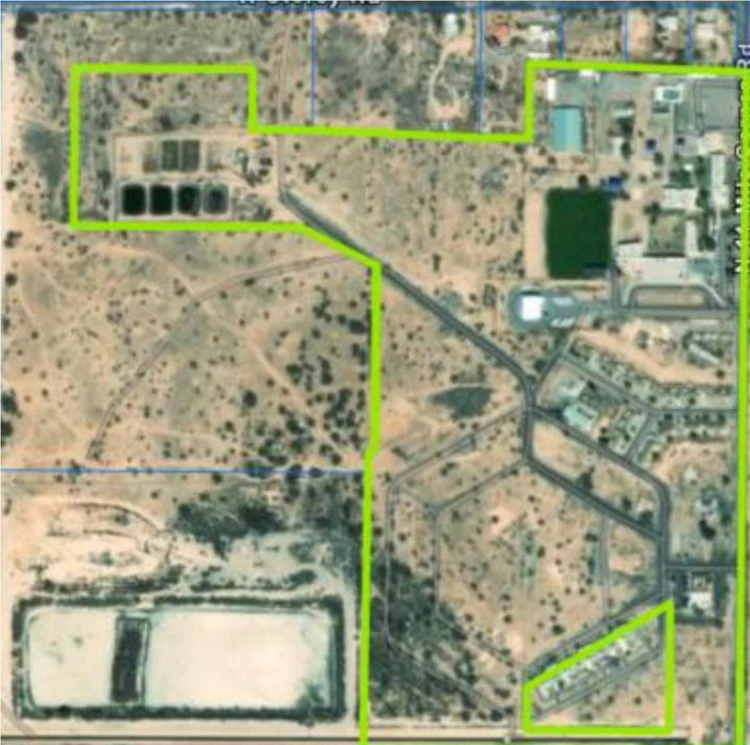
Eleven Mile Corner — This site, located in an unincorporated community between Casa Grande and Coolidge, currently includes the Mary C. O’Brien Elementary School, the Pinal County Housing Authority offices, a public housing development, and wastewater treatment facilities. The Pinal County Housing Authority reports a substantial waiting list of seniors seeking one-bedroom apartments. The site also has homeownership development potential. An initial assessment identified a need for further infrastructure investigation, and the first step is to secure a development partner.
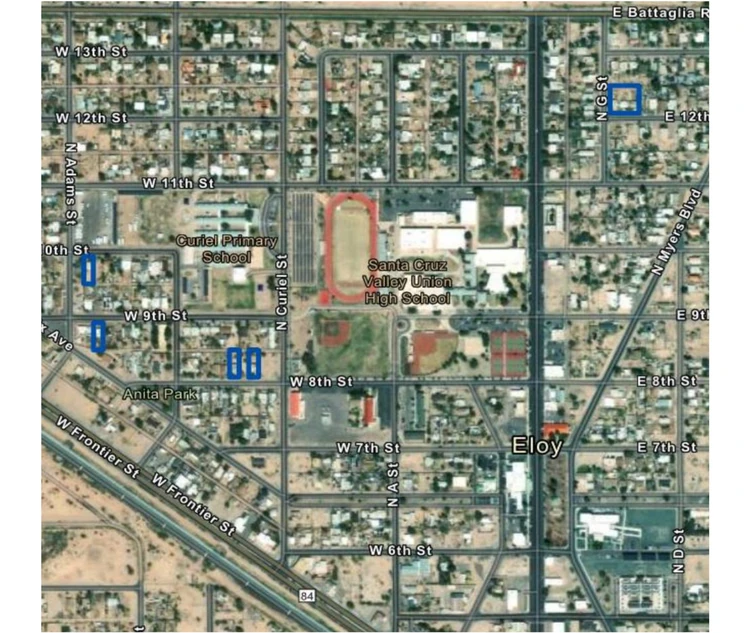
Eloy Housing Authority — This opportunity area includes multiple Pinal County-owned parcels and former vacant Eloy Housing Authority properties available for purchase. Acquisition of vacant properties is ongoing and subject to HUD approval. Many of the homes are suitable for rehabilitation and resale to first-time homebuyers. For homes not suitable for rehabilitation, demolition and new construction using a combined land lease and the county’s PLAN program model could produce significant cost savings.
The 10-Year Implementation Plan
The plan is organized around three focus areas — building capacity, preserving existing housing, and developing new homes — to be carried out over 10 years. Early efforts will focus on the two Tier 1 sites at Eleven Mile Corner and Eloy. Housing will be built and managed in partnership with nonprofits and other developers, not by the county directly. Funding comes primarily from federal grants through HUD, with the county working to ensure investments can be recycled and reused over time. The full plan is available at pinal.gov/1779/Pinal-County-Housing-Plan.
Survey Results Shaped the Plan’s Priorities
The plan incorporated input from two resident surveys and a separate county employee survey.
In the September 2025 survey, 255 residents responded. The top priorities were neighborhood revitalization (82%), affordably priced homes for purchase (78%), and housing for essential service workers and local employer employees (70%). Preferred housing types included homes on large lots (65%), modest homes with carports (63%), manufactured homes on lots (57%), and side-by-side duplexes (53%).
In the January 2026 survey, 339 residents responded. Revitalization remained the top priority at 70%, followed by affordably priced homes for purchase (63%) and affordably priced homes for rent (49%). Residents also indicated a strong desire for the county to communicate its investments (93%), publish a map of developable sites (85%), actively pursue preservation activities (69%), and test incentives (69%).
A separate county employee survey drew 506 responses, with 125 identifying as potential home purchasers. Most were seeking three-bedroom homes, and 80% considered homes priced below $300,000 to be economically sustainable. Among 19 employee renters, 85% considered rents below $1,250 per month to be economically sustainable.
The Role of Nonprofits and Development Partners
“Development is not an activity I recommend that the county pursue as its own activity,” Kuehl told the Board. “It’s something to be done in partnership or collaboration with another entity, and I’m strongly suggesting that you look at a nonprofit for that type of partnership.”
She also suggested the Board look at general funds already invested in nonprofits whose work aligns with county strategic goals, and consider directing some of that as seed money to attract a high-capacity development partner.
“I am of the strong opinion,” she added, “that if you put out a request for proposals or a request for interests, you will indeed have some high-capacity nonprofit organizations who will come to the table and say, ‘We have ideas about how we can work with you.'”
The plan identifies the potential role of a Community Land Trust — an arrangement where a nonprofit holds land and removes it from the speculative market, keeping housing costs lower over time. Kuehl explained that trusts typically operate in one of two ways. In the rental model, the trust holds the land under a long-term lease, reducing what landlords need to charge in rent. In the homeownership model, the buyer purchases the structure and takes out a mortgage on it, while making a separate lease payment to the trust for the land. When the home is eventually sold, an equity-share formula ensures it can be resold at the same income level — keeping it affordable for the next buyer. Trusts have been operating in Tempe, Tucson, and Flagstaff for decades, Kuehl noted, and are approved by FHA, Fannie Mae, and other secondary market insurers.
Supervisor Miller on Land Costs and Voluntary Demolition
Miller explained why land cost is a central challenge: when a private developer buys land, improves it, and subdivides it, the final lot cost multiplies — typically by a factor of five — to set the market price of the finished home. That dynamic, he said, is what makes the community land trust model worth examining, because the trust holds the land and removes it from the speculative market.
“It’s good to hear that there are things out there we could look at,” he said, “and that we don’t have to reinvent the wheel.”
Miller also expressed support for the voluntary demolition program planned for the plan’s later years. He noted that cities have used voluntary demolition to revitalize neighborhoods — removing blight while potentially reducing costs for a new developer. Impact fees are charges developers pay to offset the cost of public infrastructure like roads and utilities. When a dilapidated structure is demolished and a new one is built on the same lot, Miller said, the developer may qualify for a waiver because those infrastructure costs were already accounted for when the original structure was built.
“I think we could do that tomorrow,” he said. “Our legal staff will help us draft something up.” Kuehl noted that property owners who clear a dilapidated structure are generally motivated to put the land to productive use rather than leave it vacant.
Comments Accepted Through April 10, 2026
Kuehl said she will return to the Board in May with a refined plan that incorporates public comments. The Board of Supervisors is expected to take up formal adoption at that meeting, with implementation beginning in the next fiscal year. The plan will be updated annually through a report to the Board.
Residents and stakeholders may review the draft plan and submit written comments through April 10, 2026, at pinal.gov/1779/Pinal-County-Housing-Plan.