Key Points
- Council prioritized aquifer recharge over direct delivery to maximize long-term storage credits
- City Manager Rains proposed reserving 15 to 20 percent of recharge credits annually; Councilmember Herman suggested 20 to 25 percent
- Members endorsed a roughly 50/50 baseline split between industrial/commercial and residential effluent uses
- Council agreed to separate current effluent volumes from future volumes generated under the ADAWS program
- Draft strategy document expected within weeks, with a final version by end of March
CASA GRANDE, AZ – Casa Grande City Council gave direction on its effluent allocation strategy at a February 17 study session. The council prioritized aquifer recharge over direct delivery and supported setting aside a reserve. Members also agreed to separate current effluent volumes from future volumes generated as development proceeds under Arizona’s ADAWS program. They indicated the current roughly even split between industrial/commercial and residential uses should serve as a baseline. City Manager Larry Rains said a draft strategy document would reach the council within weeks, with a final version expected by the end of March.
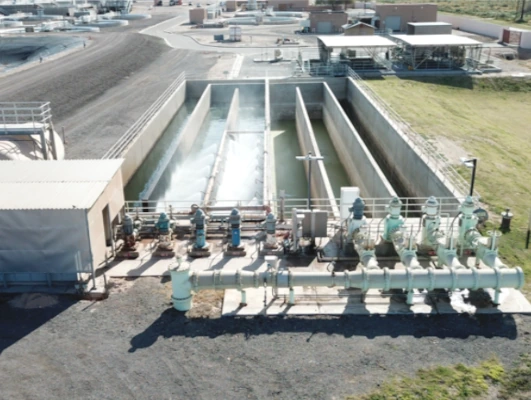
The session capped months of study on how Casa Grande manages its treated wastewater — sewage that has been cleaned at the city’s Water Reclamation Facility to A+ reclaimed water quality. The city processes roughly 6,301 acre-feet of this effluent annually — about 5.6 million gallons per day.
That treated water currently goes to two types of uses. Some is delivered directly to customers such as the Dave White Municipal Golf Course and SRP’s Desert Basin Generating Station. These direct deliveries supply water for immediate use but do not generate long-term storage credits. The rest flows into the North Branch of the Santa Cruz Wash, a managed recharge facility where water percolates into the underground aquifer.
When eligible water is stored in the aquifer for more than one year, the city can earn long-term storage credits. Those credits can be used to demonstrate a 100-year assured water supply for future development — a state requirement for approving new subdivisions. Residential development does not receive effluent directly but benefits through these credits, which can be allocated to housing projects to meet water supply requirements. In 2021, the council allocated 1,370 acre-feet of long-term storage credits to the City of Casa Grande Water Company — the city-owned utility intended to serve development, including the Copper Mountain Ranch master-planned community in northern Casa Grande. That allocation remains pending while the city awaits a decision from ADWR on its designation of assured water supply, an application that has been in process for approximately three years. The city’s recharge facility at the Santa Cruz Wash is permitted by the state for up to 3,500 acre-feet per year.
Council Endorses Recharge as Top Priority
After reviewing the city’s current allocation data, Rains asked council members whether the city should prioritize recharging effluent into the aquifer over direct deliveries to users such as golf courses and industrial facilities.
“From the team’s perspective, we want to begin to allocate effluent in a manner that will utilize all of the effluent instead of having any excess run down the wash,” he said. “I personally believe that we have to give serious consideration to recharging to our permit levels, which is approximately 3,500 acre-feet, because we generate long-term storage credits for that.”
Councilmember Anthony Edwards said the city should recharge effluent to build credits rather than give it away without earning anything in return. Councilmember Sean Dugan said, “It’s nice to get something today, but we really gotta prepare for the future.”
Dugan also warned about water scarcity. “We’re always gonna have this water issue, and it’s gonna get worse in the future,” he said. “They might change things in the future, and it would be thankful that we banked that away.”
Councilmember Matt Herman said uncertainty about future policy changes is reason enough to bank credits. “Prioritize, get the recharge, because we don’t know what we don’t know yet,” he said.
Effluent Reserve Modeled After Budget Reserves
Rains proposed holding back a portion of recharge credits each year as a reserve — similar to how the city maintains a general fund balance. Mayor Pro-Tem Brent BeDillon endorsed the idea. “We do it in our budget,” BeDillon said. “We should do it here.” He asked where the reserve would be held, and Rains confirmed it would be recharged and held as long-term storage credits rather than delivered directly. Rains said staff had discussed reserving 15 to 20 percent of recharge credits annually as a first priority.
Herman suggested the range should be 20 to 25 percent. Rains said staff would model scenarios across the full 15 to 25 percent range so the council could evaluate the impact.
Rains said the only existing commitment against long-term storage credits is the 1,370 acre-feet allocated to the city’s water company for Copper Mountain Ranch.
Mayor Lisa Navarro Fitzgibbons asked whether setting aside a reserve would still leave enough effluent to satisfy current demand. Rains called it “a good number for us to start our allocation.” He added that the council should be careful about over-committing as requests grow.
Baseline Split Between Industrial and Residential Uses
Rains presented the city’s current allocation breakdown. Today, 47 percent of treated effluent goes toward generating long-term storage credits through aquifer recharge. Another 32 percent goes to direct deliveries for commercial and industrial users. The remaining 21 percent has been uncommitted.
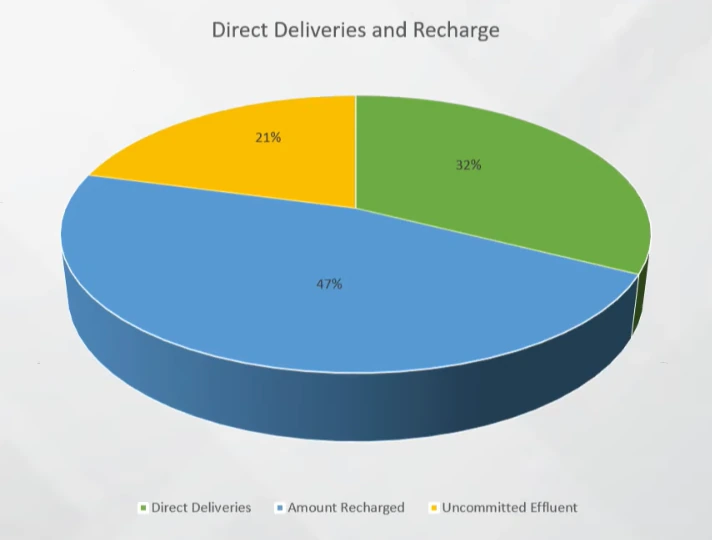
“So ultimately, what we have today is a 53/47 percent allocation — 53 percent for industrial/commercial and 47 for long-term storage credit and for residential,” Rains said. The 53 percent figure includes the 21 percent currently uncommitted, which Rains said he expects to convert to industrial and commercial direct deliveries within the next year.
He suggested formalizing a roughly 50/50 baseline split between industrial/commercial uses and residential recharge credits. Edwards indicated the current balance is already close enough. “We’re already at that, close to it — if we remain there, I think we will be okay,” he said. He added that the ratio could shift over time. “It could be residential and industrial drops down,” he said. “But right now, with what we have going on within our city, we got a lot of industrial.”
Rains said the allocation is a starting point that the council can modify on a case-by-case basis. Staff will model the exact percentages in the strategy document.
Uncommitted Effluent Expected to Shrink
“As of 2024, we were essentially finding that about 1,352 acre-feet were considered uncommitted, meaning they were running through the wash — we weren’t getting any credit for it,” Rains said. Storm activity and irrigation district discharges into the wash interrupt the city’s ability to earn credits at its recharge facility. “It’s unpredictable, and so we are very likely always going to send more effluent to the wash for recharge knowing that there’s going to be some that gets deducted because of the exceptions that ADWR has to generating long-term storage credits,” he said.
However, Rains added that “given some of the direction with the Cactus Mine and the interest of other industrial users, we believe that we’ll be able to allocate that particular uncommitted here very, very shortly.” The Cactus Mine effluent deal, authorized for negotiations by the council on January 5, would deliver up to 1,300 acre-feet annually to Arizona Sonoran Copper Company’s reopening mine.
How Recharge Permits and Thresholds Work
Councilmember Dugan asked who sets the 3,500 acre-foot permit threshold — whether the state, the ADAWS program, or some formula tied to the city’s size or population. Rains said the Arizona Department of Environmental Quality and the Arizona Department of Water Resources establish permit amounts based on hydrological studies. The permit level depends on the size of the recharge basin, the volume it can hold, and the permeability of the underlying soils. These factors vary by location.
Rains said the hydrology at the Santa Cruz Wash site would likely prevent any increase to the current cap. However, the city generates only 2,000 to 3,000 acre-feet of credits there annually. Rains said the city could close that gap by sending more effluent to the wash, which would “generate a higher long-term storage credit.”
Dugan asked whether increased recharge would support future development. “As we continue to develop these programs and put more into the ground, we should be able to pull more out,” he said. Rains agreed.
Separating Current Volumes From ADAWS Growth
The council also agreed to account for current effluent volumes separately from new volumes produced under Arizona’s Alternative Path to Designation of Assured Water Supply (ADAWS) program. The Arizona Department of Water Resources created ADAWS after groundwater models showed existing supplies may not meet demand for 100 years, effectively halting new subdivision approvals in parts of the state. The program requires new developments to rely on renewable water supplies — including treated effluent — rather than groundwater alone.
Rains recommended separating volumes because the program will change how developers interact with effluent. He said ADWR allows roughly a 33 percent credit for effluent based on the volume of water generated through a meter, which can be applied toward “replenishment and/or physical supply.” As a result, he said, “practically every development that occurs in the city will be asking for their effluent back due to some level of cost savings that they can recognize.”
Previously, developers expected the city to process and treat their wastewater without giving much thought to its usefulness. Rains said the ADAWS program “is gonna change that mindset very, very quickly with the development community.” He added that the regulatory landscape “is changing and will likely continue to change for the next year or so.”
What Residential Developers Can Expect
Herman asked how the ADAWS framework applies to residential development. “If you have a residential development, they’re gonna want 100 percent of their water back, right?” he asked.
Rains agreed that residential developers will want their effluent back but said discussions so far have been structured around what he described as a roughly 33 percent ADWR threshold — the share of metered water volume that the state accepts as the effluent allocation returnable to a development.
Herman then asked whether the city should build an additional reserve on top of that. Rains said he believes the ADAWS structure creates a natural reserve for the city because developers receive credit for only 33 percent of their metered volume, while the city processes a larger share as effluent. However, he said the details remain an area for further discussion.
The city is also evaluating whether to negotiate individual agreements with each developer or enter a single agreement with Arizona Water Company, the private utility that provides water service in much of the Casa Grande area. Rains said a single agreement could prove more efficient. Staff currently anticipates that most new development will formally request effluent be returned or allocated to their project — either for subdivision platting or to reduce their water resources fee.
Recharge Basins Will Spread Across the Community
Rains said that as development expands under ADAWS, the city will need recharge infrastructure beyond the Santa Cruz Wash. “It’s highly likely that we will not have recharge basins just in one location of this community,” he said. “It’s very likely that they will be spread throughout our community.”
According to Rains, long-term storage credits generally must be recovered within the area of hydrologic impact of the recharge facility — which he described as roughly a one-mile radius in Casa Grande’s case. This geographic constraint drives the need for multiple sites.
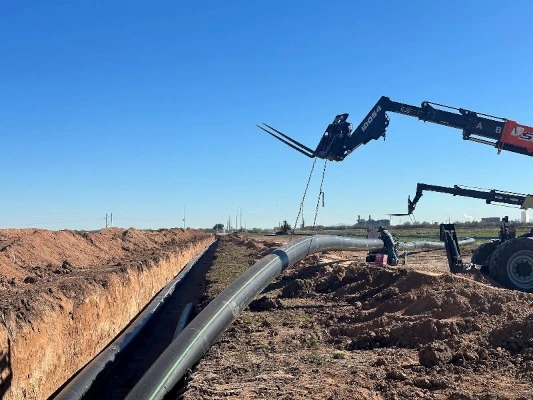
Rains noted the city’s recent infrastructure work. “The city has worked very diligently the last five to seven years on establishing reuse infrastructure — our recharge of the facility at the Santa Cruz Wash, as well as the reuse line that we built through our industrial corridor,” he said. “All of those are valuable pieces of infrastructure as we look to efficiently allocate all of our treated effluent.”
Growth Modeling and Annual Reviews
Rains said the team has taken a conservative approach to projecting future effluent volumes. Staff is modeling growth at 1.6 to 2 percent annually, which aligns with groundwater usage data from Arizona Water Company. As population and industry grow, effluent volumes should increase accordingly — though Rains said conservation and low water usage have produced “a bit of a changing pattern.”
The mayor asked whether the strategy would be evaluated annually. Rains confirmed it would, particularly in the early years. “One of the reasons we’re establishing this as a strategy is that we want a little bit of flexibility in it today because there’s still a lot of things taking shape,” he said.
Strategy Document Expected by End of March
“The team, both internal and external staff, will be working on the strategy document that we will get out to the mayor and council roughly in draft form in the next couple weeks,” Rains said.
Rains noted the council may choose to formally adopt the strategy or treat it as a guiding framework. He said he has not yet discussed the question with City Attorney Brett Wallace. Meanwhile, the Cactus Mine effluent purchase agreement remains under negotiation and will return to the council for final approval at a future meeting.