Key Points
- The Maricopa Planning and Zoning Commission voted 4–2 on March 9 to recommend approval of Sunrise Ranch, a 150-acre residential development near SR-238.
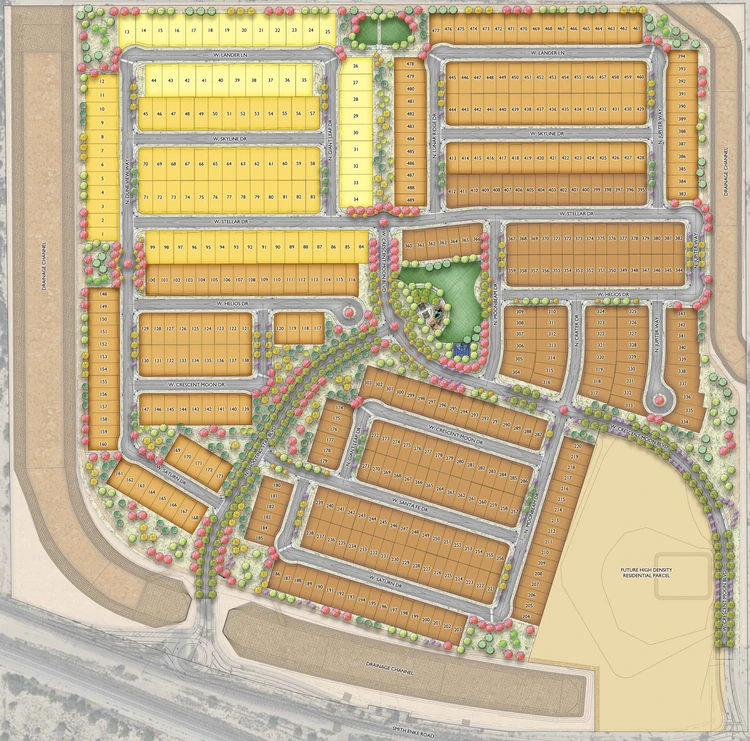
- The project includes 489 standalone houses and a smaller section of townhomes and patio homes on a designated 13-acre parcel.
- About 34% of the site, 50.81 acres, is set aside as open space with pedestrian trails connecting to the city’s broader trail network.
- The entire site sits within a Special Flood Hazard Zone; federal approval is required to remove homes from the floodplain and relieve future residents from mandatory flood insurance.
- The development requests smaller lots than city standards allow, with 79% of lots measuring 45 feet wide or less.
- A 38-foot height limit on the townhome and patio home section effectively prevents apartments, but the city cannot legally require units to be sold rather than rented.
- Two multi-lane roundabouts are planned for SR-238 access, raising concern from commissioners and residents about high traffic speeds and large trucks on the road.
- City Council will hear both cases on Tuesday, April 7, 2026, at 6:00 PM at City Hall.
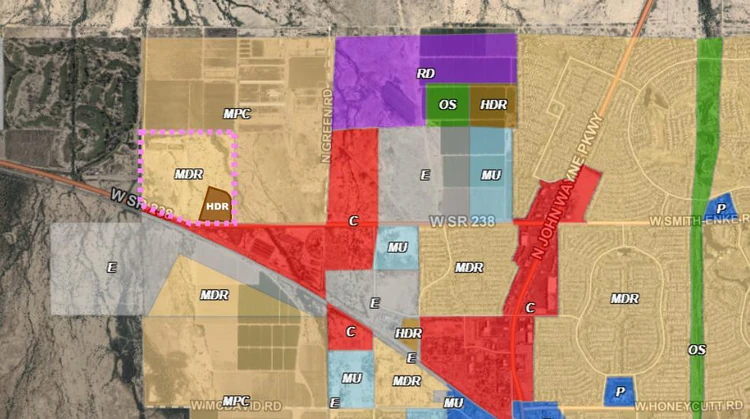
MARICOPA, AZ —The Maricopa Planning and Zoning Commission voted 4–2 on March 9, 2026, to recommend approval of the Sunrise Ranch residential development, a proposed 150-acre community located approximately half a mile west of the northwest corner of State Route 238 and N. Green Road.
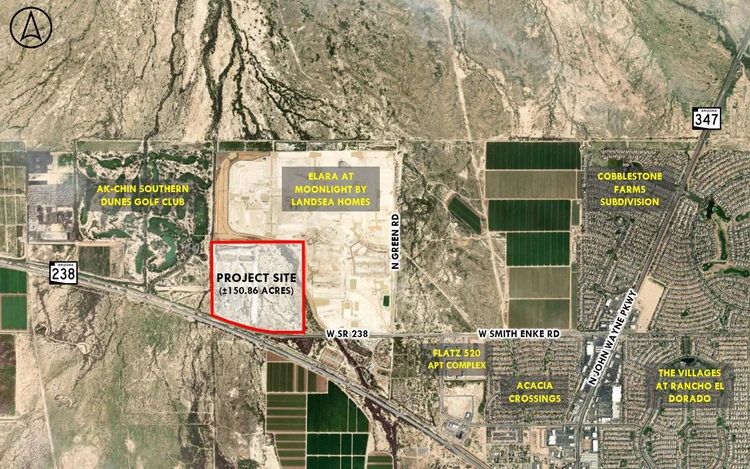
Commissioners Robertson and Whittle voted against. The commission considered two related applications simultaneously and forwarded both to City Council. The first was a General Plan Amendment to support townhomes and patio homes on 12.94 acres. The second was a Planned Area Development, or PAD, a custom zoning designation that establishes tailored development standards for a specific site, covering the full 150.86 acres rezoned from Industrial Zone (CI-2). The applicant is law firm Gammage and Burnham, representing property owner Dozerland, LLC, a Nebraska-based family ownership entity. If Council approves the project at its April 7 hearing, Sunrise Ranch could bring 489 single-family detached homes plus attached housing to a site that was zoned industrial prior to Maricopa’s incorporation and has remained vacant. A preliminary plat for the development, Case SUB-25-07, is already on file with city staff for review, representing the next stage in the process where detailed infrastructure and lot boundary decisions will be made.
489 Homes, Trails, and Transit on 150 Acres
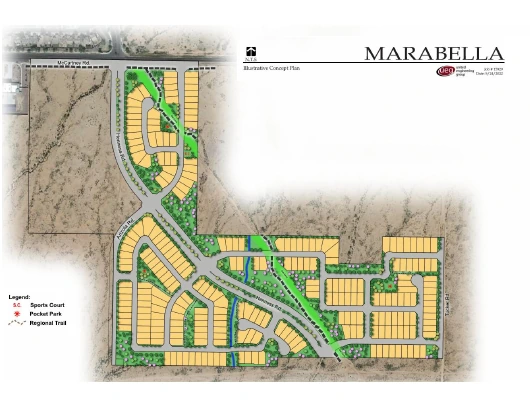
The project includes 489 single-family detached homes — standalone houses on individual lots — spread across approximately 137 acres. The attached housing component, on a designated 13-acre parcel in the southeast corner of the site, would include townhomes, condominiums, and patio homes — units that share one or more walls.
Additionally, the project sets aside 50.81 acres, about 34% of the gross site, as usable open space. That open space includes pedestrian trails throughout the interior of the community, trails around the perimeter, and connections to the city’s broader parks and trails network. The project also includes a bus bay for the Maricopa Express Transit system.
The site is directly adjacent to Moonlight Ridge, an approximately 489-acre master-planned community of about 1,500 homes approved in 2021, which is currently under construction to the north and east.
Lot Sizes, Housing Products, and Deviations from City Standards
The Sunrise Ranch PAD requests several deviations from the City of Maricopa’s standard RS-5 zoning rules for single-family detached homes. Specifically, the PAD would reduce the minimum lot area from 5,000 square feet to 4,500 square feet and reduce the minimum lot width from 50 feet to 40 feet. It would also increase maximum lot coverage — the percentage of a lot a building can occupy — from 55% to 60% for single-story homes and from 50% to 55% for multi-story homes. Building height and setbacks remain unchanged at 30 feet and 15 feet front and rear respectively.
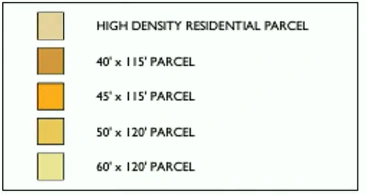
Of the 489 proposed single-family detached lots, the sizes break down as follows:
| Lot Size | Count | Share |
|---|---|---|
| 40′ × 115′ | 227 | 46% |
| 45′ × 115′ | 163 | 33% |
| 50′ × 120′ | 67 | 14% |
| 60′ × 120′ | 32 | 7% |
Vice Chair Robert Klob noted that 79% of all lots in the development would be 45 feet wide or smaller, producing homes roughly 30 to 35 feet across.
Because the type of attached housing product had not yet been determined, the PAD presents two lot size options to accommodate a range of possibilities, compared against the city’s standard Multiple Unit Residential (RM) zone:
| Standard | RM Zone | Option A | Option B |
|---|---|---|---|
| Lot Area | 7,000 sq. ft. | Up to 2,499 sq. ft. | 2,500–6,999 sq. ft. |
| Minimum Lot Width | 60 feet | 20 feet | 30 feet |
| Max Building Height | 36 feet | 38 feet | 38 feet |
| Open Space | 20% of site | 20% of site + 50 sq. ft. private | 20% of site + 50 sq. ft. private |
Stephen Anderson, an attorney with Gammage and Burnham presenting on behalf of the applicant, said the attached housing lots were designed to create an alternative to apartment buildings, spreading units across individually platted lots.
The PAD also requests a deviation from the city’s standard maximum residential wall height. The standard is 6 feet. The PAD requests 8 feet, designed as 2 feet of retaining wall with 6 feet of screening on top. Anderson explained the reason: because of significant drainage impacts across the site, an 8-foot wall allows engineers to avoid constructing tiered walls that would consume additional land.
The Flood Zone, Vekol Wash, and What It Means for Future Homeowners
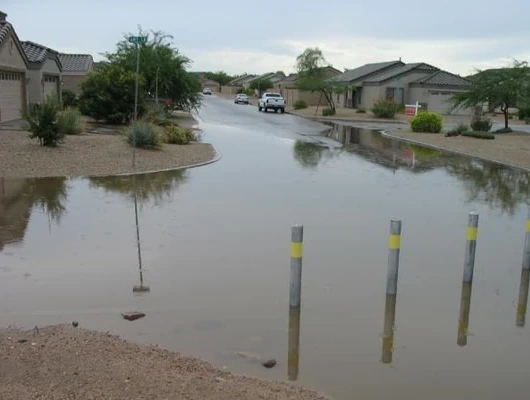
The site is bordered by two drainage features: the Vekol Wash running along the eastern perimeter, and a separate drainage wash along the west that wraps to the south. As a result, the whole of the site currently sits within a Special Flood Hazard Zone, which would normally require future homeowners to carry flood insurance.
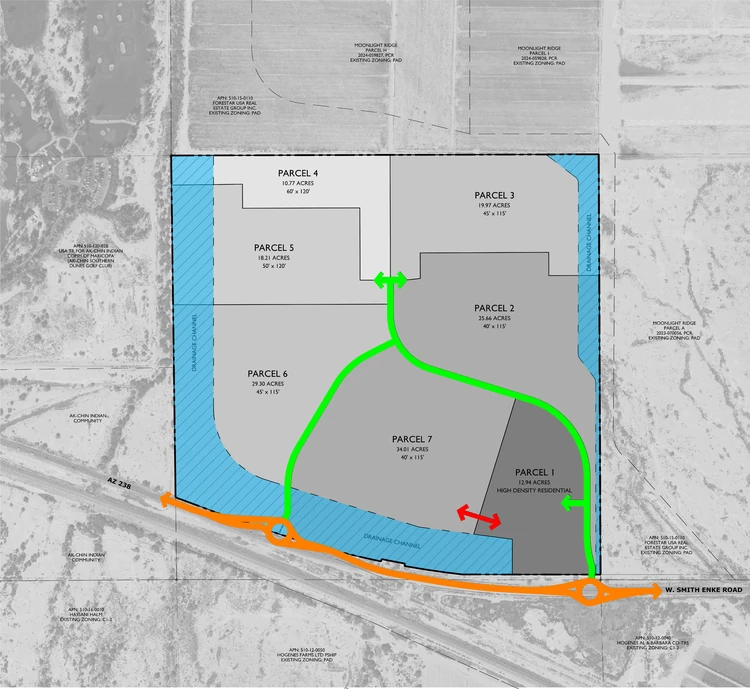
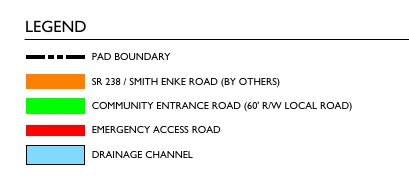
Before homes can be built, the developer must apply for a Conditional Letter of Map Revision (CLOMR) and subsequently receive a Letter of Map Revision (LOMR). These federal processes, if approved, would formally remove the residential portions of the site from the floodplain. That removal would relieve future property owners from the flood insurance requirement.
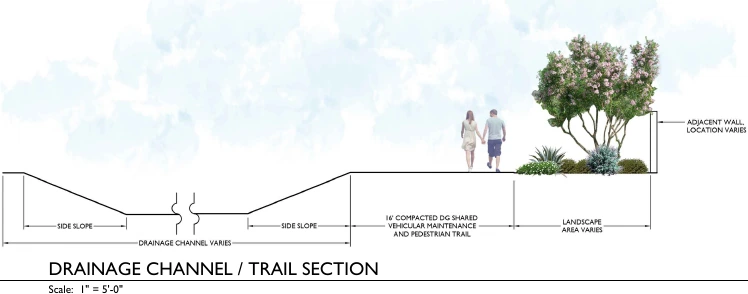
In the meantime, Anderson said the team has “viewed the drainage corridors as an opportunity on the site to create open space and recreational and trail opportunities.” Open space trails are planned along and within the Vekol Wash basin, with elevated trail paths on the sides and access along the bottom of the wash as well. Commissioner Robertson asked whether the open space was primarily drainage area rather than traditional parkland. LaRee Mason, Associate Planner, confirmed it was, saying the project is “trying to create a walkable space with vistas and broad horizon areas.” Robertson said he had no objection: “I really don’t have any problem with that if it’s developed as such, and not just left a sand wash.”
Why Staff Supported the Project
City staff recommended approval of both cases, citing the project’s alignment with goals of the Maricopa General Plan. The 2025 Housing Needs Assessment Update, referenced repeatedly during the hearing, identified a shortage of what planners call “missing middle housing” — condominiums, townhomes, duplexes, and patio homes — housing types the Sunrise Ranch development would introduce to the area. The General Plan identifies SR-238 as a growth area in need of roadway improvements and increased pedestrian connectivity. Staff concluded that Sunrise Ranch advances both priorities.
The staff report also found that the project contributes to SR-238 roadway improvements, increases pedestrian connectivity via trail corridors, and places traffic volumes along major arterials. Sunrise Ranch does not include a commercial corner, though commercial land exists on the south side of SR-238 in the General Plan.
Height Cap Blocks Apartments, But Rentals Remain Possible
A central concern at the hearing was whether the attached housing units, while not apartments, could end up being rented out rather than sold.
Commissioner Robertson opened the line of questioning, asking whether apartments would be permitted under the PAD. Planning and Zoning Manager Rick Williams clarified that the 38-foot maximum building height established in the PAD’s attached standards makes it essentially impossible to build a conventional vertical apartment building on the site. He pointed to Homes at Maricopa as an example of the kind of apartment development that the height cap would prevent. Williams said any future attempt to build beyond those standards would require returning for a PAD amendment — a full public hearing process in front of the commission and City Council.
Anderson confirmed that intent directly: “We do not want to be able to build apartments on the site. We’ve crafted the development standards with the idea that that will not be possible… If someone in the future wanted to build apartments on the site, they would have to come back with a PAD amendment, which would go through the full public hearing process.”
However, Vice Chair Klob pressed on a more difficult question: even if apartments are technically blocked, what prevents the attached units from being rented out? He pointed to duplexes already operating as rentals throughout Maricopa as an example of how attached housing can shift from for-sale to for-rent over time. “Once we approve this, it could evolve to that, and there’s nothing anybody can do to stop it,” Klob said.
Anderson acknowledged the concern and asked City Attorney Tina Vannucci to weigh in. Vannucci confirmed that a state statute prevents the city from regulating whether units are sold or rented. “It’s not unique to this property. We will never be able to tell somebody that has to be for sale.”
Anderson had also raised the issue of condominium liability, noting that many Arizona architects, engineers, and contractors avoid condo projects due to legal exposure — condominium associations can sue on behalf of all unit owners for construction defects, creating significant collective liability risk. He said legislation introduced this session to address the problem had stalled, but that he expected a striker amendment before the legislative session ends.
Commissioner Thomas: Why the Small Lot Sizes?
Commissioner Maurice Thomas asked Anderson to explain why the attached housing lots drop from the standard 7,000 square feet to under 2,500 square feet in Option A. He said he struggled to envision raising a family of two or three children in a home that small and questioned whether the market was truly demanding it.
Anderson explained that the concept is counterintuitive. He described Options A and B as the functional alternative to apartment buildings. When you take a conventional apartment structure and eliminate the vertical stacking, he said, you spread the units across individual lots. Those lots are smaller, but each unit becomes a separately owned property rather than a rented apartment. “The idea here is to create ownership opportunities so that people can have the right to purchase on individual lots,” Anderson said.
Thomas reflected that downsizing trends appear real, even if people’s belongings haven’t shrunk to match — observing that the rise of self-storage facilities may be the consequence. Anderson added that the 13-acre high-density parcel represents only about 8% of the overall site. The remaining 92%, he said, is the single-family detached community, and that remains the project’s primary purpose.
Purple Pipe and Wastewater: Unanswered Questions
Commissioner Ted Yocum raised a question that caught the room’s attention. He noted that the applicant’s materials referenced purple pipe infrastructure — a distinctively colored piping system used to transport recycled, non-potable water for purposes such as irrigation, helping prevent cross-contamination with the drinking water supply. He asked whether that system would extend throughout all phases of the project, and whether it would apply to any future commercial development in the area — commercial land that exists in the General Plan on the south side of SR-238 but is not part of the Sunrise Ranch development itself.
Mason deferred to the applicant on infrastructure questions. Anderson confirmed that purple pipe, if used, was envisioned for the single-family detached portion. “I do not know that there would be the possibility, or the need for it, in the higher density residential single family attached area,” he said.
Chandra McCarty from EPS Group, the project’s engineering firm, then addressed the question directly. “The answer to the purple pipe question is probably not that exciting,” she said. “I don’t think that there is any reclaimed water available to connect to in Smith-Enke Road that we’re connecting to there. So we can do more research. It hasn’t come up from our engineering reviews up until this point. They haven’t asked about us using it or asked us to connect to it and I don’t think it’s available, but we can add it to a note to find out.”
Yocum explained his interest: “I can’t remember the last time I saw the purple pipe infrastructure mentioned in an application that we’ve had. I was interested in what you were going to be doing with it and to what extent. And likewise, the wastewater management.”
Anderson noted that infrastructure questions like purple pipe would be resolved at the next stage of the process, referring to the preliminary plat already on file: “There is a plat sitting behind this case. A lot of the technical details that you would expect to be resolved on platting remain outstanding.”
Roundabouts on SR-238 Draw Concern
Vice Chair Klob observed during the staff presentation that the circulation plan appeared to show two roundabouts on SR-238. “People are gonna freak out when they see this,” he said.
Anderson said the roundabouts were effectively settled — the traffic impact analysis had already been reviewed and approved by the city, with two multi-lane roundabouts planned for SR-238 access. Mason said she believed one is already in the city’s Capital Improvement Program, while the second is not.
During public comment, Maricopa resident Randy Dodson was the only member of the public to speak at the hearing, raising the roundabouts as his sole concern: “My only concern is the roundabouts on 238 with the speed limit at, I think, 60 at that point, at least 55 — which means 70 in Maricopian terms, right? That’s gonna be hard to go around a roundabout and for people to even be able to get out of the roundabout with those trash trucks barreling down there and having a hard time coming to a stop, or a reasonable slowness to go through it.”
Commissioner Chad Whittle echoed the concern: “Those roundabouts make me a little nervous with those trash trucks coming. The congestion of traffic with more houses and all of the things on 238 already is gonna be really crazy for some of our homeowners.”
Klob’s Broader Concern: Housing Diversity Across the City
Vice Chair Klob used the Sunrise Ranch discussion to raise a concern that extended beyond this single project. He said he had spoken with prospective city council members and sitting council members about housing diversity in Maricopa, and that a common concern kept emerging: the city has been approving mostly small-lot developments.
“I’m just really concerned about the direction that the community is going,” Klob said. “We’re getting pigeonholed with only small lot developments. Where I agree that we need it — I’m not denying that fact — but we also need more diversity.”
Klob noted that he wants to see Maricopa attract executives, doctors, and other professionals who might accompany hospital and commercial development. He made the concern personal: “I look at my daughter and son-in-law who live in town, and they’re in a nice little three bedroom, two bath, 1,800 square foot home. Other than buying an existing home, there’s nowhere for them to move up to. They’d have to leave the city.”
Anderson responded that approving the PAD would not bar larger lots in the future — if the market shifts, the preliminary plat could be adjusted to accommodate them. Klob pushed back, noting that market signals only change if larger lots are made available. “If all we’re building are 4,500 square foot lots, if that’s all that’s available, that’s all anybody’s expecting,” he said.
Klob ultimately voted in favor of both cases, saying the attached housing product is something the community “desperately needs,” even if it is widely unpopular on social media.
City Council Hearing Scheduled for April 7
Despite notices mailed to surrounding property owners and a neighborhood meeting on February 19 that drew no attendees, no written comments were received prior to the hearing, and Randy Dodson was the only member of the public to speak. The Planning and Zoning Commission’s 4–2 recommendation now advances both GPA25-03 and PAD25-04 to the Maricopa City Council. The Council is scheduled to hear the items on Tuesday, April 7, 2026, at 6:00 PM at City Hall in Maricopa. Residents who wish to comment may attend the hearing or submit written comments to the Planning and Zoning Division.