At a Glance
- Code discussion: Commissioners questioned why the county’s 90-foot monopine limit is consistently exceeded
- Aesthetics discussion: Several commissioners questioned placing a monopine design in a desert with no pine trees
- Stealth design discussion: Some commissioners asked whether stealth design should be required at all, suggesting a plain tower painted in neutral tones may be preferable
- Case: SUP-012-25 — 125-foot monopine wireless tower
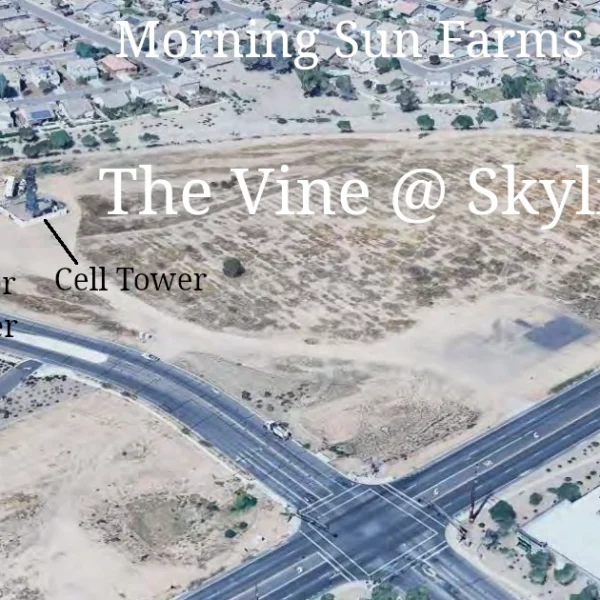
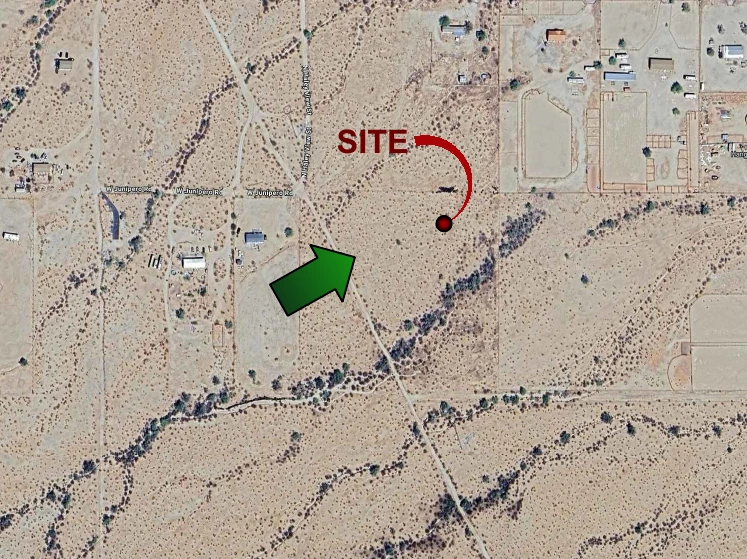
- Location: W Junipero Road and N Haley View Street, southwest of the City of Maricopa and the Ak-Chin Indian Community
- Owner: Vertical Bridge; Verizon is the first tenant
- Vote: Unanimous recommendation of conditional approval with 19 stipulations
- Next: Board of Supervisors makes the final decision
The Pinal County Planning and Zoning Commission unanimously approved a 125-foot cell tower on Feb. 19, 2026, but the hearing prompted questions about the county’s wireless facility code. Commissioners questioned why the county limits monopine towers to 90 feet when federal law sets no height cap — and commissioners said recent applications have consistently exceeded that local standard. The tower, designed as a monopine, would rise near W Junipero Road and N Haley View Street southwest of the City of Maricopa on a roughly 10-acre parcel in unincorporated Pinal County if the Board of Supervisors grants final approval.
Improved Cell Service for a Rural Area
The proposed facility aims to improve coverage and capacity for both residents and businesses in the surrounding community. According to staff, this enhancement will support public safety, economic development, and quality of life.
Barry Weatherspoon, representing applicant CenterLine Communications, explained that the 125-foot height was chosen because the tower’s owner, Vertical Bridge, plans to attract multiple wireless carriers. “The higher tree allows for multiple carriers,” Weatherspoon said. He added that one carrier has signed up so far, but Vertical Bridge is attempting to bring in three to four carriers “so that the entire community can be serviced.”
Commissioner Karen Mooney asked whether a fifth carrier could fit on the structure. Weatherspoon confirmed that would be possible but noted, “Who’s that fifth carrier?”
Why Vertical Bridge Wants 125 Feet
Weatherspoon explained that the tower’s height is driven by the need for antenna separation between carriers. “The lower it is, you wouldn’t be able to accommodate the additional carriers because they have to have a certain amount of separation between antennas,” he said.
Commissioner Gary Pranzo asked Weatherspoon about the tower’s signal reach. He wanted to know whether it could extend to the City of Maricopa from its rural location. Weatherspoon replied that greater height generally means greater range. However, he could not give a specific distance. “Each carrier has different spectrums, so each carrier may be a different distance,” he said. A detailed RF study would be needed to determine exact propagation.
Pranzo said he wanted more specific data. “I was kind of hoping that somebody sat down and said, ‘Okay, we need so many watts to reach Maricopa and this is the height we need to get over the horizon,'” he said. He later added, “I think we need to work on more tangibles so that we can adjust our heights to meet this.”
Vertical Bridge, Verizon, and How the Carriers Fit In
Weatherspoon clarified that Vertical Bridge — not Verizon — will own the tower. CenterLine Communications represents Vertical Bridge in the application. Verizon is simply the first tenant. Vertical Bridge’s business model centers on building towers and then leasing antenna space to multiple wireless carriers.
The 90-Foot Monopine Limit and Federal Law
Much of the discussion centered not on this specific tower but on the county’s wireless facility code itself.
Commissioner Daren Schnepf raised the issue first. “If there is no federal limit, why do we have a code that says 90 feet if it will never be sustained at 90 feet if somebody wants to put 125 feet in?” he asked. “It just seems a little different to me to have no regulation on the Federal Communications end, but then we have something in there that’s permitted up to 90 feet but it will surpass that every time.”
Planning Manager Harvey Krauss offered a possible explanation but did not give a definitive answer. “I don’t know the history of that, but I believe probably our code preceded the federal regulations and we haven’t gone back and changed our code to reflect practices and requirements by the feds,” he said. He suggested the Telecommunications Act of the 1990s likely came after the county adopted its height limit.
Vice Chairman Robert Klob raised a similar concern. “We have a limit of 90 feet and I can’t remember the last time we actually had one that was 90 feet,” Klob said. “They’re all 105, 110, 120, 130. Why do we have a code? Where does it end?”
Krauss: County Code Should Align With Federal Law
Krauss acknowledged that the county’s code needs to better align with federal law. “We need to probably align our code with federal law because we have a similar case coming up at the Board of Adjustment with the ham radio operators that have some rights through the Federal Communications Agency, but our code is much more restrictive,” he said.
Schnepf suggested the issue could be addressed during a code update process currently underway. “Maybe that’s something we look into when we’re doing our code update that we’re in the process of doing” he said. Krauss agreed.
Can the County Still Limit Tower Heights?
Vice Chair Mooney asked staff whether the county’s local code is essentially overridden by federal rules that set no height limit. Krauss said the county does retain authority to limit height — but it needs a valid justification.
“You do have the ability to limit the height. You don’t have to go with 120 feet,” Krauss said. He suggested that the typical height of a real pine tree — far shorter than 120 feet — could serve as a reasonable basis. “I think the thought being 90 feet — what’s the typical height of a pine tree? Probably not 120 feet, so you could justify it based on that,” he said.
Additionally, Senior Planner Sangeeta Deokar noted the applicant bears responsibility for FAA compliance. “The applicant is required to also submit it to the FAA, even if it falls in the flight path,” she said. “That is the applicant’s responsibility to get that approved.”
A Pine Tree Design in a Desert With No Pines
Commissioners also discussed the tower’s appearance. Commissioner Tom Scott questioned the choice of a pine tree design in the desert. “I was just curious why you chose the model pine, being that there’s no pine trees within 200 miles of there,” he said.
Weatherspoon explained that the pine design can conceal antennas for multiple carriers. “If we did a palm tree, it really only stealths one carrier,” he said. “Within the pines, you can hide multiple arrays of antennas.”
Scott questioned whether the design fits the area. “It doesn’t make sense way out there on the western part of the county where it’s nice and hot all the time,” he said. He suggested the tower could instead resemble a water tower or saguaro — something that would blend into the landscape.
Weatherspoon said that approach has limits. “If you had four carriers, then it doesn’t look like a water tank. You’re looking at a silo,” he said.
Should Stealth Design Be Required at All?
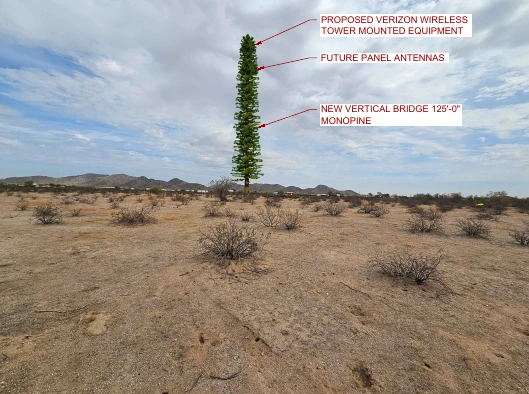
Klob referenced the simulation image showing the monopine on the desert horizon.
“There is nothing, other than the mountains beyond, there’s nothing out there that is remotely close to this height,” Klob said. “I think I understand the requirement of some type of stealth design, but this sticks out really like a sore thumb. And it impedes the beauty of the desert with something that is not natural. And granted, it’s a tower, so it’s not natural. I get it. But there’s no pine trees either.”
He continued: “I’ve said it before — I’m actually not 100% opposed to just leaving it as a tower. It is what it is. It’s out in the middle of the desert. It’s serving a purpose. It needs to be 125, 130 feet. Let it be what it is. Why go to the added expense of trying to mask this thing when it actually makes it worse in my vision.”
Weatherspoon responded that CenterLine was open to alternatives. “We’re open to that, if that was the recommendation,” he said. “Maybe paint to match neutral tones to stealth.”
Klob suggested a simple brown or rust color instead. He also mentioned the idea of a water tower design, noting that water towers can reach 80 to 90 feet and the height would not be “out of the realm.”
Other Commissioners Weigh In on Design
Other commissioners offered their perspectives. Mooney said she supports the monopine design. “I’m from back east, so the pine tree looks cool,” she said. “I don’t personally like the look of just the towers out there with all the panels on them. This hides it.”
Schnepf agreed with Mooney. “I’d rather look at a pine tree than a big tower or something,” he said. “Even though it’s in the middle of the desert. And I’m not opposed to the 125 feet, because it serves more people.”
Pranzo said he would prefer no stealth design at all. “I like ducks to look like ducks when they quack and walk like ducks,” he said. “A communication tower, to me, if it’s done with good workmanship, is a thing of beauty. Why hide it? It’s an asset that’s serving the community.”
Klob said the issue should be addressed in a future code update. “Maybe this is something for us in the future to address in the code and maybe have alternatives for the community to have a different style of poles or towers,” he said. He added that this concern should not hold up the current applicant.
Krauss noted that the county’s code requires stealth design above a certain height and lists options including monopine and palm tree designs. He said he has seen other designs that could better blend into the environment.
The Site and Its Surroundings
The site is owned by James Puls and zoned GR (General Rural). It lies south of W Desert Valley Road, southwest of the Ak Chin Indian Community. The site has no prior development history or permits. High-tension electric lines traverse the property, and the monopine would sit 288 feet from those lines.
The structure includes stealth pine branches extending to 129 feet with a lightning rod, faux bark cladding on the trunk, and no climbing pegs or exposed unpainted metal. The facility compound will be enclosed by an eight-foot masonry wall with a secured gate, housing equipment cabinets, a multi-meter utility center, and a backup diesel generator. The facility will be unmanned, with technicians visiting roughly once per month.
Minimal Public Opposition
Staff initially reported no letters of opposition. However, during the presentation, Planner Sam Amaya corrected the record. He noted that one letter of opposition had been received from a property owner to the south. No members of the public spoke during the hearing’s open comment period.
The applicant conducted public outreach including a neighborhood meeting on Sept. 29, 2025, and a neighborhood mailout on July 30, 2025. Site posting and broadcast sign posting occurred in late January and early February 2026.
Unanimous Approval With 19 Conditions
Pranzo moved to forward a recommendation of conditional approval to the Pinal County Board of Supervisors. The motion passed unanimously with no opposition from any commissioner.
The approval carries 19 stipulations. Among them: the applicant must submit an RF engineer’s certification within 30 days of Board of Supervisors approval confirming FAA and FCC compliance. All future co-located antennas must be concealed within the pine branches. The facility must meet Lighting Zone 1 requirements. If the tower is inactive for six months, it must be removed within 180 days at the applicant’s expense. A complete site plan process must also be completed before any building permits are issued.
The commission’s vote is a recommendation only. The Pinal County Board of Supervisors will make the final decision on case SUP-012-25.