At a Glance:
- What: The Vine @ Skyline — a proposed mixed-use development with 118 residential units (28 townhomes, 90 apartments) and six commercial building sites on roughly 16 acres
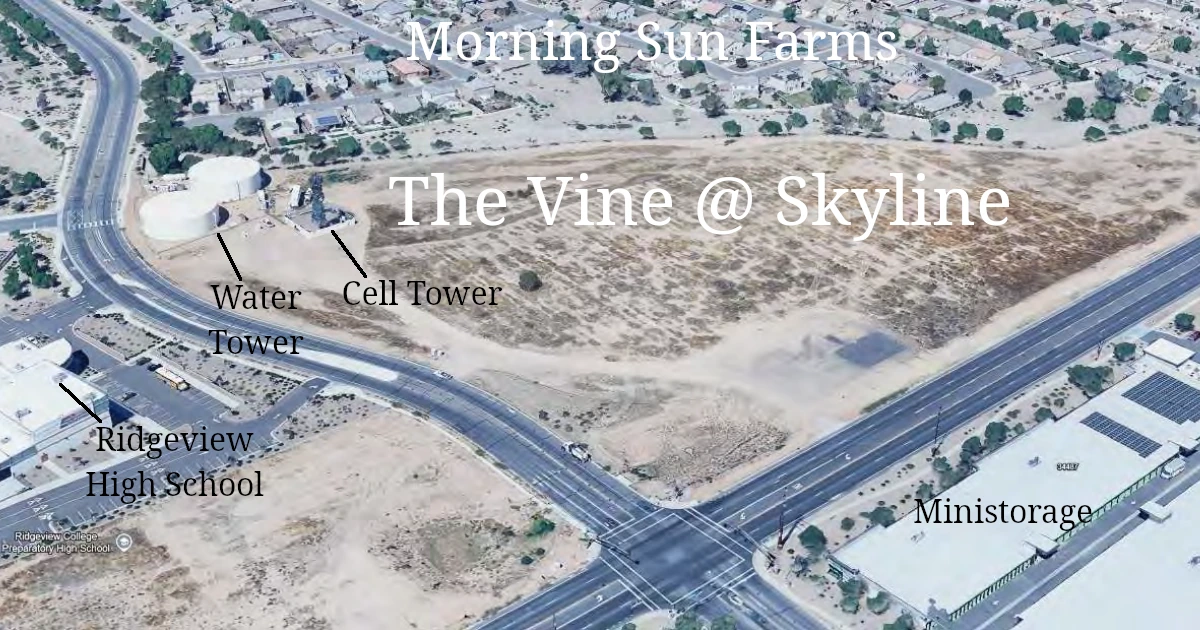
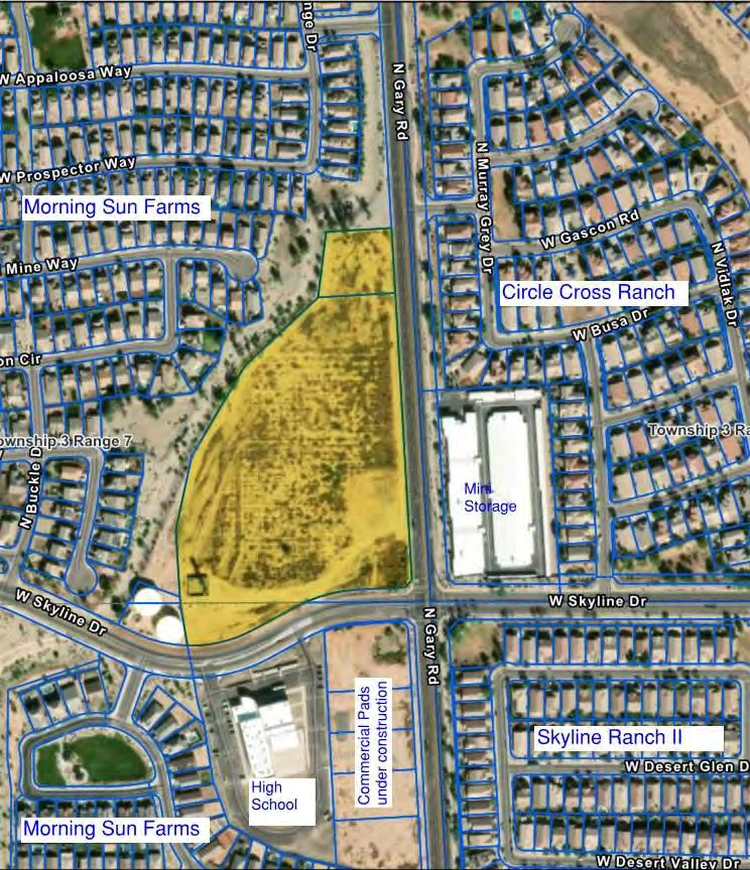
- Where: Northwest corner of W Skyline Drive and N Gary Road, San Tan Valley
- Developer: K&I Homes on behalf of property owner Cravath Whole Life Communities
- Only confirmed tenant: Terrible’s gas station and convenience store on the corner lot. Other anticipated uses include drive-through restaurants, a sit-down restaurant, a bank, and a daycare. The applicant said years of marketing failed to attract commercial tenants to the site
- Commission vote: Recommended denial of the comprehensive plan amendment 5-3; motion to deny the rezoning failed on a 4-4 tie
- Why: Commissioners who voted to recommend denial cited traffic concerns, existing rental vacancies, and the loss of commercial-zoned land
- What’s next: Both cases advance to the Pinal County Board of Supervisors for a final decision
SAN TAN VALLEY, AZ — The Pinal County Planning and Zoning Commission voted on February 19, 2026, against advancing The Vine at Skyline, a proposed mixed-use development at the northwest corner of W Skyline Drive and N Gary Road in San Tan Valley. Both cases now go to the Board of Supervisors for a final decision.
The project would have brought 118 residential units and six commercial building sites to roughly 16 acres of land surrounded by established single-family neighborhoods. Commissioners who voted to recommend denial cited traffic concerns, existing rental vacancies, and the loss of commercial-zoned land. Those who voted in favor of the project pointed to the live-work potential of mixed-use development and the site’s difficulties attracting commercial tenants.
What The Vine at Skyline Would Bring to the Neighborhood
Developer K&I Homes, on behalf of property owner Cravath Whole Life Communities, proposed a mixed-use project on a site where the bulk of the land has sat vacant since 2008. The Cravath family originally owned the farmland and created the parcels when Morning Sun Farms was developed around 2008, retaining this commercial site. Its name references the land’s earlier history. “The reason it’s called The Vine is that they used to actually farm grapes there for wine production,” applicant Kristjan Sigurdsson told commissioners.
The eastern portion along Gary Road would retain its General Business (CB-2) zoning and host six commercial building sites. “In terms of Terribles, yes, we have a lease signed with them,” said Cole Cravath, who represents the property-owning family, of a gas station and convenience store planned for the corner lot. The remaining sites are designed for uses such as drive-through restaurants, a sit-down restaurant, a bank, and a daycare facility. However, no other tenants have committed. “We don’t have anybody signed up yet,” Sigurdsson said.
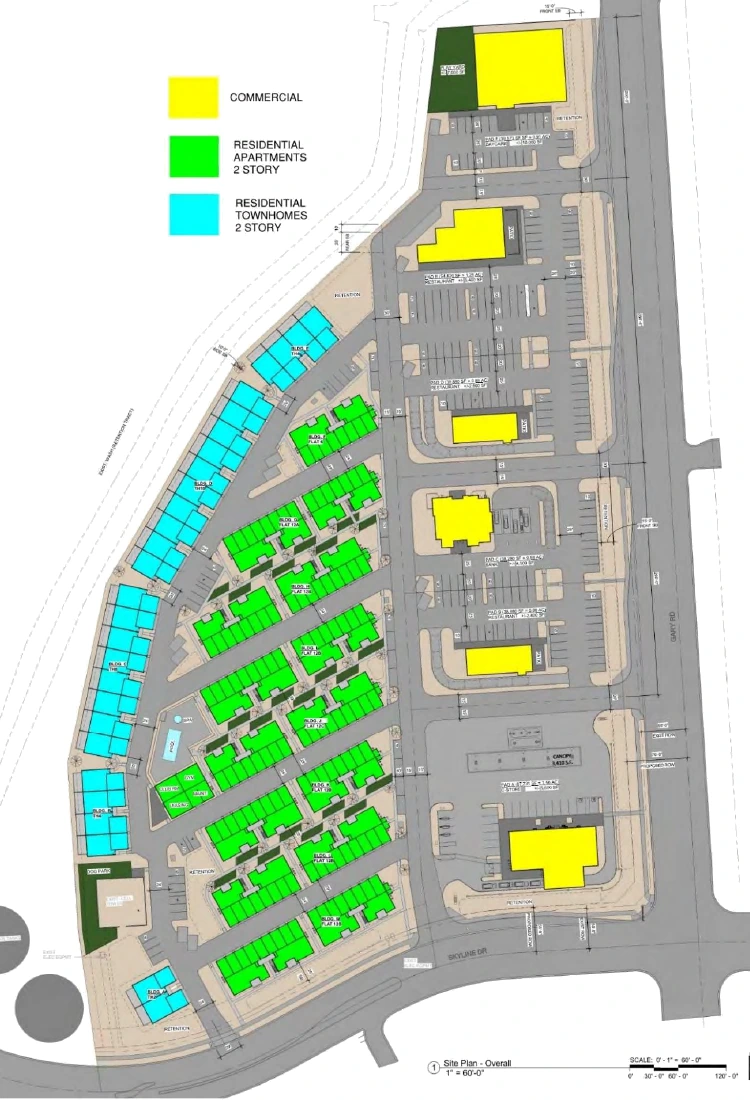
The western portion would be rezoned from General Business to Multiple Residence (MR) to accommodate 28 three-bedroom townhomes and 90 apartments in a mix of one- and two-bedroom units.
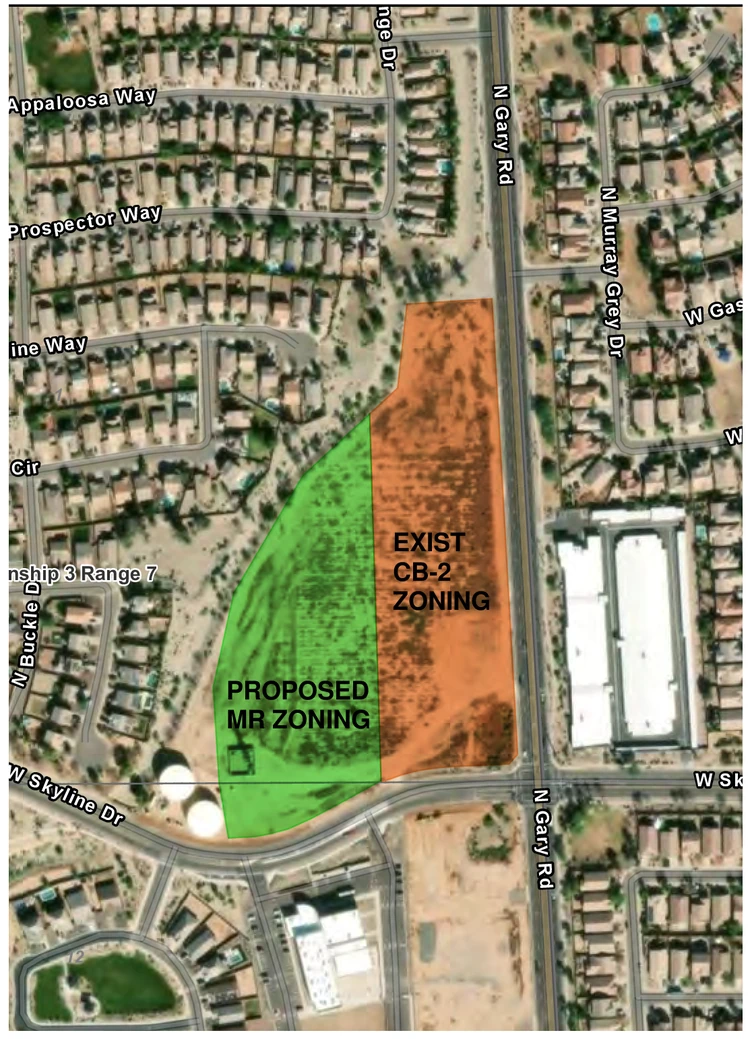
The rezoning also requires an amendment to the San Tan Valley Special Area Plan, a 2018 land use plan that overlays the broader Pinal County Comprehensive Plan and governs development in San Tan Valley. The site is currently designated Suburban Neighborhood, and the applicant sought to change it to Community Center, which allows multifamily housing alongside commercial uses. The residential area would span about 7.7 gross acres at a density of roughly 16 units per acre. All buildings would stand two stories tall at a maximum of 26 feet. The southwestern corner of the site contains a water facility and a wireless communications facility. The wireless facility has been in place since approximately 2016, according to the staff report.
Townhomes would sit closest to the existing Morning Sun Farms homes along the western boundary. Apartments would occupy the middle of the site. An existing drainage tract averaging 150 feet wide already separates the site from the Morning Sun Farms homes to the west.
The townhomes would each include a two-car garage, and the apartments would also have attached garages. Sigurdsson said these garages account for about 90% of the parking required under county code. The remaining parking for visitors would be provided in about 30 surface spaces distributed throughout the residential area, with additional overflow available in the commercial parking lot during off-peak hours.
Why the Applicant Chose a Mixed-Use Approach
The Cravath family’s involvement with the land dates back roughly 30 years. Cravath explained that years of marketing failed to attract a major commercial tenant to the site. The primary obstacle is a large retail power center at Hunt Highway and Gary Road, located just half a mile south. That center includes three big-box anchors and multiple commercial lots and shops.
The Vine @ Skyline site sits about half a mile north of the retail power center at Hunt Highway and Gary Road, which the applicant said has drawn commercial tenants away from the property for years.
“That center has been building up over the years and we’ve been unable to secure any tenants for this site,” Sigurdsson said. “Can’t leave it sitting forever, so we came up with the mixed-use idea.”
He described the site as a difficult fit for purely commercial development. “It’s technically too small for a big-box anchor and it’s too big for lots of shops without an anchor, so it’s kind of like a half breed in between,” he said. An anchor is a large store, like a Home Depot or WinCo, that draws enough customers to support smaller businesses around it. Access from Skyline Drive adds another challenge. A raised divider on Skyline Drive prevents left turns into the site, school traffic from Ridgeview College Prep across the street adds congestion, and curves in the road limit drivers’ visibility of the property. These factors make the rear portion of the site difficult for customer-facing businesses, according to Sigurdsson.
Cravath added that other uses were explored. He said he believes Tractor Supply visited the site at one point, but the access constraints deterred them. A mini-storage facility that he said would have been “really appropriate for the site” instead went across the street. Motorhome storage was considered but would not be a high-value use, he said. Cravath said he had someone run the numbers on a hotel, but it was “not a good use case” for the site. He said medical office space was also a poor fit because of the distance from HonorHealth and competing commercial land closer to that hospital. Light manufacturing was also mentioned as a possibility.
“Frontage at the power center at Hunt and Gary is pretty much saturated at this point. I think In-N-Out just took the last pad,” Cravath said. He noted that three years ago, the family brought a much larger multifamily concept to the county. “We had a much more comprehensively designed multifamily idea where we just kept the hard corner and the whole thing was apartments,” he said. “The feedback we got from the county is that, ‘Hey, we really want to have some commercial frontage.’ So, this is the plan we’ve brought.”
Traffic Data and the Apartments-Cause-Congestion Debate
Sigurdsson addressed traffic directly in his presentation, which stated: “The idea that apartments increase traffic and cause congestion is a myth, not reality.”
“Our traffic study shows that the residential component of this site plan actually has about 15% of the traffic volume that the commercial does,” he said. According to the applicant’s trip generation data, the commercial portion would produce approximately 4,710 daily trips compared to 832 for the residential portion. During the evening peak hour, apartments would generate 71 trips versus 456 for the commercial buildings.
Sigurdsson said the traffic study was based on physical sensor measurements taken at the intersection while school was in session during the week. “Their 600-page report that cost us $20,000, so I’m sure it’s accurate,” he said of the study.
Recently elected Vice Chair Karen Mooney, who lives in San Tan Valley, pushed back on the findings. “Those intersections that were provided in the staff report and yours are not what I drive no matter if it’s eight o’clock at night or 11 o’clock in the morning,” she said. “It’s an extremely busy intersection, and I just think it would get a lot of traffic. That intersection does not look like that 90% of the day.”
County Engineer Chris Wanamaker confirmed the traffic study was completed in August 2025 and said his office reviewed it, though the report has not yet been formally approved. A raised median on Gary Road would restrict the southernmost driveway to right-in, right-out only, while the middle driveway would allow turns in all directions.
Sigurdsson also noted the project would dedicate an additional 25-foot right of way along the Gary Road frontage — nearly two acres — back to the county for turn lanes and a potential future third lane. Mooney asked Wanamaker whether that dedication was a requirement of the development. He confirmed it was.
How Much Commercial Land Would Be Lost
If approved, the rezoning would convert about 7.7 acres from General Business to Multiple Residence, reducing total commercial acreage at the intersection from about 28 to 21 acres. According to the applicant’s presentation, the San Tan Valley Special Area Plan states that no neighborhood commercial development shall exceed 25 acres when combined with all four corners of an intersection. At 28 acres, the site currently exceeds that threshold. Sigurdsson said the reduction to 21 acres would bring it into compliance.
San Tan Valley Mayor Daren Schnepf, who sits on the commission, noted that approximately 100 acres of commercial land across San Tan Valley have already been rezoned to other uses in recent years. “My challenge is the middle there,” he said, referring to the apartment buildings. “We are limited in what we have.”
However, Schnepf said the site’s difficulty attracting commercial tenants may not be permanent. “There’s the argument that you’re not gonna get anybody to come in on commercial for this size. Maybe, maybe not,” he said. As San Tan Valley’s population continues to grow, he suggested, commercial interest could follow. “With population comes commercial and industrial. The more people are out there, the more the commercials are gonna want a piece of that.”
Schnepf Weighs In on Density, Height, and Medical Office Space
Schnepf probed the applicant on several design details. He asked why the apartment portion could not be less intensive — perhaps detached units or single-level buildings.
Sigurdsson explained that a minimum of about 100 units is needed for cost-effective property management with full-time leasing and maintenance staff. At roughly 16 units per acre, he said the project is “very low density” compared to typical multifamily projects he has designed over two decades, which typically exceed 20 to 30 units per acre. The garages consume building footprint that would otherwise house more units. “Only half of that has a ground floor. So it’s really only a one-story product on top of the parking garage,” he said of the apartment buildings.
Schnepf then asked about building height. “If this was to go forward, would you be accepting of a stipulation that said only two stories?” he asked. “Because right now, if you get the zoning, it could go three.” Sigurdsson immediately agreed. Staff later drafted a formal stipulation limiting all multifamily and apartment structures to two stories or 30 feet, whichever is more restrictive.
Schnepf also asked whether the applicant had considered medical offices for the apartment portion. Cravath said he consulted a broker who specializes in medical office space. Beyond the location challenges, he said it costs roughly $100 per square foot to build out a medical office interior, making it a risky investment at this location. However, Cravath said a dental or similar medical-adjacent use could potentially fit on the northernmost commercial lot.
Ownership, Long-Term Hold, and the For-Sale Question
Commissioner Tom Scott asked whether the Cravath family plans to retain ownership of the property after construction. Cravath confirmed that the family intends to hold the property long-term. He said this approach is reflected in the design, which prioritizes lower density, quality materials, and tenant retention over maximum return on investment.
“This isn’t gonna be a good property to sell,” Cravath said, “because it doesn’t fit the tone and tenor of most of the stuff that other people purchase.” He explained that typical buyers want high-density projects that are easy to manage and replicate. He said the design would make it difficult to resell but well-suited for long-term ownership.
Recently elected Chairman Robert Klob raised a related concern about the lack of for-sale product in growing communities like San Tan Valley. He noted that condos and other middle-tier ownership products are no longer being built, leaving a gap between renting and buying a single-family home. “I think it could be a great product to help a lot of people get into an ownership scenario,” he said of the townhomes. He said the rental-only approach “misserves the community a little bit.”
Despite that reservation, Klob expressed support for the live-work concept. “Overall, I like the concept of kind of a live-work scenario. I think that could be attractive to someone having a sit-down restaurant, being able to have staff and waitstaff being able to live across the street,” he said. He voted in favor of the project on both items.
Vacancy Rates and Housing Demand
Mooney raised concerns about existing rental vacancy rates in San Tan Valley. “We are approximately 40% vacancy rate, and with almost 1,000 that have been approved already that haven’t broken ground yet,” she said. “That just really concerns me on how much more do we need.”
Sigurdsson responded by referencing the Pinal County Housing Plan. “Your own housing study actually anticipates another 10,000 rentals being needed,” he said. “I don’t know what the exact numbers are in terms of inventory and what that vacancy rate represents in terms of number of units, but I don’t think it’s anywhere near what is gonna be required.” He added that, according to the same plan, less than half a percent of the housing inventory in Pinal County is multifamily. The San Tan Valley Special Area Plan similarly notes that detached single-family homes account for 99.5% of all housing units in the area.
Mooney also raised a broader economic point during the discussion of stipulations. Chairman Klob proposed requiring 50% of commercial development to be completed before the multifamily units could receive a certificate of occupancy. Mooney opposed this as too restrictive. “If the economy were to tank like it did in ’08, that is very unfair to the applicant,” she said. In a downturn, she noted, cost-effective housing would be especially needed. Other commissioners agreed, and the phasing stipulation was not included.
What Residents Told the Commission
Several Morning Sun Farms residents spoke during the public comment period.
Ken Battey, who was recently nominated to the Town of San Tan Valley’s Interim Planning Advisory Committee, said he collected signed letters from neighbors with direct views of the site. None were supportive. “I didn’t have one person happy about it,” he said. The top concerns were traffic and property values. Battey said he supports more commercial development on the site, such as small offices or shops where residents could start businesses. “We need more tax dollars in San Tan Valley,” he said. “And you gain more tax dollars in a commercial property than you do in any private property at all.” He added, “We all have to leave San Tan Valley to go make an income.”
Barbara Staniszewski, also of Morning Sun Farms, cited traffic, density, and concerns that the apartments could eventually become Section 8 housing. She said the area would be better served by community facilities like a fire station or post office. Trudy Norko, a third Morning Sun Farms resident, echoed concerns about traffic from the three proposed Gary Road entrances and water use. She said a restaurant would be a better fit for the area than apartments.
Commissioner Pranzo Compliments the Plan but Votes to Deny
Commissioner Gary Pranzo praised the application but voted to recommend denial. “I compliment the applicant for the thoroughness and the thoughtfulness that have gone into this project,” he said.
However, he cited quality-of-life concerns for future residents. He said there was no adequate buffer between the commercial and residential portions of the site. “This is a very busy place that, personally, just my opinion, this is a nightmare for the people who live there and for whoever is going to manage this complex,” he said. He would have preferred the entire site remain commercial and said San Tan Valley is “already what I would consider overbuilt” in residential rentals.
How Commissioners Voted and Why
The comprehensive plan amendment (PZ-PA-020-25) was recommended for denial 5-3. Commissioners Scott, Pranzo, Mooney, Schnepf, and Lizarraga voted to recommend denial. Chairman Klob, Commissioner Hartman, and Commissioner Keller voted to support the project.
Schnepf addressed the applicant directly as the commission moved on. “Might I just say good luck to the applicant at the Board of Supervisors,” he said.
Both Cases Head to the Board of Supervisors
The commission’s votes are recommendations, not final decisions. Both items will go before the Pinal County Board of Supervisors for action. The Board has the authority to approve, deny, or modify the proposals regardless of the commission’s recommendation. Residents who wish to provide input can submit written statements to the Pinal County Community Development Department or attend the Board hearing when it is scheduled.