At a Glance
- The Town Council reviewed draft Articles 4, 5 and 6 of the new town code on Feb. 4.
- Article 4 covers budgeting, procurement rules and claims and liability.
- Article 5 creates a police department framework. The town can contract law enforcement through an intergovernmental agreement instead of hiring its own force.
- Article 6 establishes a magistrate court. Court services can also be contracted out.
- The full 15-article code must be adopted by the council’s last meeting in May to take effect by July 1.
- No formal vote was taken. The presentation was for review and discussion only.
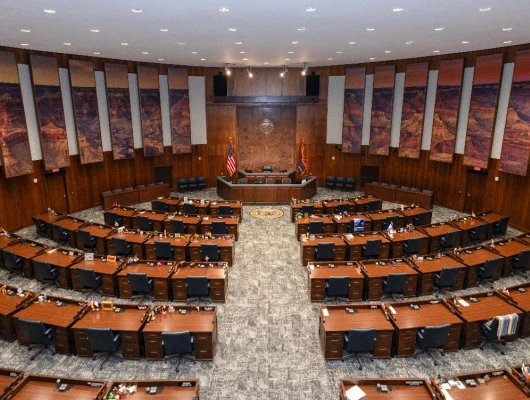
SAN TAN VALLEY, AZ – The San Tan Valley town code moved forward Wednesday as the Town Council reviewed three new draft articles on finances, public safety and courts. Attorney Joe Estes of Pierce Coleman PLLC presented Articles 4 through 6 at the Feb. 4 meeting. The code must be adopted in time to take effect by July 1, 2026 — the date San Tan Valley assumes full municipal authority from Pinal County.
What the Town Code Means for San Tan Valley Residents
The town code will serve as the rulebook for how San Tan Valley operates. It determines how tax dollars are spent, how contracts are awarded, who oversees law enforcement and how the court system functions.
Town Manager Brent Billingsley described the code as the “spinal cord” of the new government. “It’s a set of rules that we follow that are the basis of who we are,” he said. Every department the town creates — from police to fire to public works — will connect back to this document.
In total, the code will span 15 articles. The council first discussed the code development process in November and reviewed Articles 1 through 3 at its December 17 meeting, covering general provisions, mayor and council duties, and administration. Articles 4, 5 and 6 were presented Wednesday. The remaining articles will cover business regulations, traffic, animals, parks, health, building codes and planning and zoning.
How the Town Will Spend and Contract
Article 4 establishes the town’s fiscal year from July 1 through June 30. The town manager prepares the annual budget and the council approves it. The article also creates an investment policy for future reserves.
The code sets spending thresholds that govern how the town buys goods, supplies and contracted services.
- Under $5,000: No formal process required.
- $5,000–$9,999: At least three informal bids — verbal quotes or emailed estimates.
- $10,000–$49,999: Three written bids with detailed documentation.
- $50,000 or above: Formal public bidding process.
These dollar thresholds are not locked in by state law. Billingsley told the council the spending tiers are its own decisions. “A lot of those things aren’t set in statute,” he said. “Those are decisions that you make.” A future work session will give members the chance to adjust these levels.
The code also provides exceptions to the standard bidding process. Construction projects fall under Arizona Title 34, which caps what a government can build in-house. Everything above the cap must go out to bid. Billingsley said a 1990s lawsuit involving Achen-Gardner Construction and Pinal County helped establish how the statute is applied. Professional services such as engineering are selected based on qualifications rather than price. Estes noted that engineers “have a really good lobby” and that under state law, pricing cannot be included in bid documents for those services. The town must evaluate the quality of responses first and can only ask about price after the qualifications process is complete. Emergency purchases are permitted when circumstances require it. The town can also use cooperative purchasing agreements. These allow the town to skip its own bidding process and instead use a contract that another government entity has already bid out, such as a state contract.
Article 4 also includes a local vendor preference, which allows the town to favor local businesses on purchases up to $50,000. “You want to support your local vendors when possible,” Estes said. Additionally, it establishes a formal bid protest and appeals process based on lessons from other municipalities where vague language led to court challenges.
The draft also addresses claims and liability. The town attorney will manage claims under state law, including indemnification of employees and elected officials. Exclusions apply in cases of misconduct or bad faith.
Police, Emergencies and the Contract-vs.-Employee Question
Article 5 establishes the framework for a police department and emergency management. The code provides for a chief of police who reports to the town manager, with authority to enforce laws and ordinances.
However, San Tan Valley does not need to hire its own police force right away. The code allows the town to contract law enforcement through an intergovernmental agreement. Estes drew on his experience as a former Maricopa City Council member to explain. When Maricopa first incorporated, it contracted with the Pinal County Sheriff’s Office. The sheriff’s office assigned a commander who Billingsley said served as “essentially the police chief” on-site, reporting to the town manager for the contracted role. Maricopa later formed its own police department. “I was on the council when we did that,” Estes said.
Billingsley confirmed this arrangement. He added that the same model applies to other positions. “It’s similar for town engineer,” he said. “We have to have a town engineer, but that may be by contract, not as an employee.”
Estes pointed to Litchfield Park as another example. That city contracts police services with Avondale, which assigns designated officers who function as its police leadership.
For emergency management, the code designates the town manager as emergency director and requires an emergency operations plan. The mayor holds authority to declare emergencies under Arizona law. Estes cited COVID-19 restrictions and recent flooding in Globe and Miami as examples of when municipalities have used that power.
Courts, Hearing Officers and How the Justice System Will Work
Article 6 establishes a magistrate court for San Tan Valley. As with the police department, the town can contract court services through an intergovernmental agreement. Estes noted that neighboring Queen Creek does this. Because that town straddles both Maricopa and Pinal counties, “depending on where you may or may not get your traffic ticket depends on where you go see a judge,” he said.
Separately, Article 6 allows hearing officers to handle lower-level civil, criminal, traffic and juvenile matters, as well as code enforcement cases. Billingsley said the town plans to include access to Pinal County’s hearing office through a future intergovernmental agreement. Decisions by hearing officers can be appealed under state statute.
Council and Staff Lead the Drafting Process
Council members and staff addressed the question of public involvement in drafting the town code.
“Typically, when it comes to a town code or a city code, it’s not a public process,” Billingsley said. “This is you guys’ rules as the founding fathers and mothers of this organization.” The council receives draft language, provides suggestions and then debates those decisions in a public work session. “The public process is making the hamburger at a work session or at a council meeting, not necessarily asking the community to help write the code,” he said.
Billingsley compared the council’s role to that of the founding fathers drafting the Bill of Rights. “You have your founding fathers, and they determine how we’re going to operate as a government entity within the confines of state law,” he said. He noted that certain parts of the code — particularly the zoning code — will involve public outreach because they directly impact residents.
San Tan Valley is governed under Title 9 of the Arizona Revised Statutes as a general law town. Pinal County, by contrast, operates under Title 11. Billingsley noted the two frameworks are “very different,” which is why the county code cannot simply be carried over.
Councilmember Rupert Wolfert acknowledged the scale of the effort. “What you’re delivering is a core framework that is compliant with Arizona law,” he told Estes. “What we really need right now is those essentials.”
How the San Tan Valley Town Code Is Being Drafted
Estes is a partner at Pierce Coleman PLLC with over 20 years of municipal law experience. His firm represents over 24 municipalities across Arizona.
Billingsley noted that Estes is “not just an attorney” but “an ex-council member that served a number of years as a city council member for our fast-growing city,” calling it “unique experience that he can bring to the table.” Estes served on the Maricopa City Council from 2005 to 2010, first filling a vacancy after serving on the city’s inaugural Planning and Zoning Commission, then winning re-election.
Billingsley recounted his first week on the job. Both had independently researched other town codes. “He brought all that to the table and said, ‘I learned this, I took this from this code, what do you think about this?'” Billingsley recalled.
Estes also referenced his involvement in drafting the charter for Litchfield Park, the newest charter city in Arizona — a process that had not occurred in over 30 years. San Tan Valley is not a charter city, but that work also involved building a governance framework from the ground up.
Estes said the drafts draw on his firm’s experience across Arizona. “That’s not to say it’s gonna be perfect,” he said. “But we want to take what we’ve learned from our experience and make this the best it can be.”
Accessing the Code Online Could Cost Thousands
Vice-Mayor Tyler Hudgins asked about making the town code searchable online. Billingsley said the town has been exploring digital codification services such as MuniCode, which reformat adopted code into an interactive system where users can click defined terms and navigate between linked sections.
The cost, however, is significant. Billingsley said the town recently received pricing estimates. During a back-and-forth with an attendee in the audience, the per-page cost was estimated at $23 to $29, though that figure was described as a year old and has not been verified with current vendors. Billingsley mentioned a 460-page code as a rough point of reference for estimating the cost.
Estes cautioned that getting the code right the first time matters, since updates carry additional costs. The town will need to budget for the online codification after adoption.
Fifteen Articles by May to Meet the July 1 Deadline
Billingsley said the full town code must be adopted at least 30 days before July 1 to allow for a required referendum period. Estes said the goal is to have the final version ready by the council’s last meeting in May.
Estes said the team plans to bring three to four articles to the council each month between now and then. The next batch will include Article 7 on business regulations, Article 8 on offenses, Article 9 on traffic and vehicles, and likely Article 10 on animals.
Council members can submit edits at any time. Billingsley said the intent is to hold a work session before final adoption to walk through the entire code. Billingsley said changes in one section may affect others, which is why the full walkthrough is planned.
Estes emphasized that no code is permanent and can be amended as the town learns what works. But the goal is to start with a comprehensive code. When Maricopa incorporated, it wholesale adopted Pinal County’s code. “It just did not work,” Estes said. Years of piecemeal amendments followed.
The council took no formal vote on Articles 4 through 6. The presentation was for review and discussion only.